
When Cal Kestis Whispered, the Empire Trembled
Cal Kestis's refined Mind Trick transforms negotiations into branching, high-stakes encounters in the Star Wars Jedi sequel.
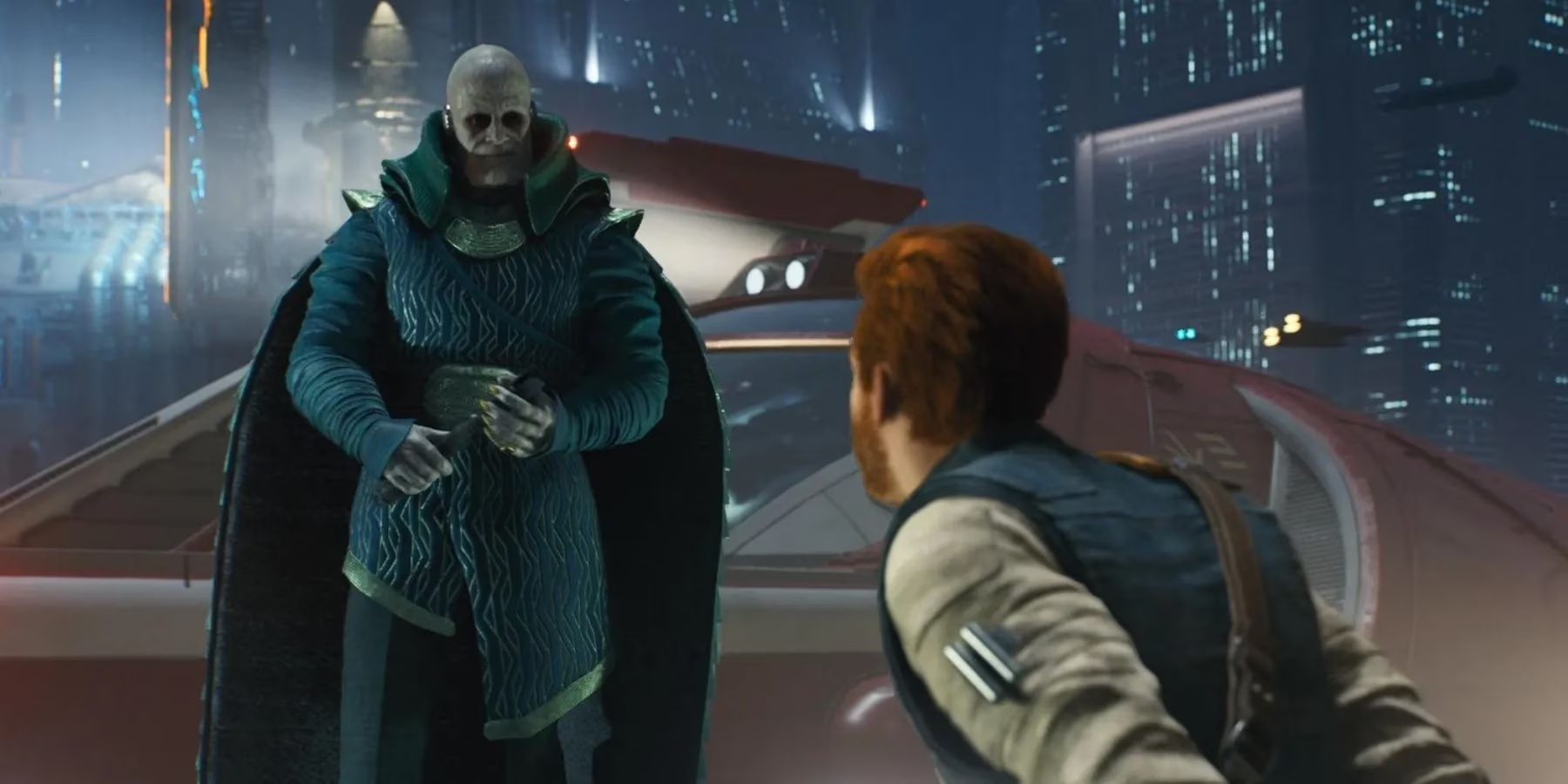
The neon-slicked rain of Coruscant’s lower levels had a rhythm Cal Kestis knew too well—a drumbeat of desperation that matched the limp of his worn boots. Twenty years had passed since the Purge, and yet every skittering probe droid still smelled like smoke from the Jedi Temple. He ducked into an alley near the Uscru Entertainment District, his lightsaber hilt hidden beneath a poncho, his mind already reaching outward, tasting the fear of the Imperial officer three blocks ahead. Bode Akuna was gone. Cere was a whisper in the Force. But BD-1’s excited chirp from his shoulder reminded him: the fight wasn’t over. Not yet.
The first time Cal had used a Mind Trick in the field, during the desperate early days after the Mantis crew scattered, it was messy. A terrified Stormtrooper had been ordered to “move along,” and the man had stumbled into a speeder lane. Cal carried that weight for weeks. Now, in what many called the twilight of the Empire, his mastery over the technique had become something else entirely—a scalpel rather than a hammer. The sequel to his earlier adventures, which released in late 2025, didn’t just hand the Mind Trick to players as a scripted novelty. It wove the ability into the fabric of every encounter, turning dialogue into danger and whispers into branching paths.
That night in the alley, the Imperial officer was a data courier named Kestal. Cal needed access codes to a prison transport carrying captured Rebel saboteurs. BD-1 projected a wireframe of the man’s nervous system onto Cal’s eye display: heart rate erratic, pockets lined with stims. The old Cal might have charged in, saber blazing. The new Cal—older, more scarred, more aware that the line between Jedi and Inquisitor was thinner than a kyber crystal’s edge—simply stepped out of the shadows and raised his hand.
“You will unlock the console and forget you saw me,” he said, the Force wrapping around his words like silk. A radial menu flickered into existence before Cal’s eyes, representing the choices only he could perceive—a choice between ‘Compel Obedience’ and ‘Sow Confusion.’ In earlier missions, these options had been illusions, leading to the same canned outcome. But since the Purge Troopers had adapted, since the Empire had begun training its officers to resist psionic manipulation, a single wrong inflection could turn a sleeper agent into a screaming alarm.
Cal chose Sow Confusion. A gamble. The officer’s eyes glazed over, then snapped back with paranoid fury. “Rebel scum!” he shouted, fumbling for his sidearm. Two Imperial Security Bureau agents burst from a nearby café, and BD-1’s holoprojector immediately painted the environment with trap markers. This was the new reality: a failed Mind Trick didn’t just close a dialogue box—it carved an entirely different path toward the objective. Cal was now forced to sprint through a bustling transit terminal, leaping over luggage crates and dodging blaster fire, before diving into a maintenance shaft that wouldn’t have been needed if the trick had succeeded. The game world itself contorted around his choices, making every conversation a crossroads. 🌌
The shift had been controversial among fans at first. Purists argued that a Jedi shouldn’t be penalized for a narrative choice, that the beauty of a Star Wars tale lay in its inevitability. But Respawn’s sequel, widely praised as a sleeper hit of 2025, proved that branching Mind Tricks elevated replayability without sacrificing emotional weight. Data miners later discovered over forty possible permutations for the Kestal encounter alone. Some routes led Cal to a peaceful resolution where the officer later defected, leaving a datapad with a heartfelt message. Others ended in tragedy, with the officer’s family targeted by the ISB. The game kept a silent tally of Cal’s telepathic interventions, and by the final act, his Force alignment would shift subtly—unlocking different saber stances, altering NPC reactions, and even changing the color of his blade’s glow if he leaned too heavily on domination. 🤯
Back in the shaft, Cal’s breathing steadied. BD-1 whistled a reproachful tune, projecting a small chart of his master’s rising stress levels. “I know, buddy,” Cal murmured, wiping grease from his cheek. “Next time, I’ll play it safe.” But even as he said it, he knew the truth: the galaxy had no safe corners left. Every Mind Trick was a mirror, reflecting the Jedi he was becoming. Would he be like Obi-Wan, who used the ability to avoid conflict entirely? Or would he slide into the territory of Revan, whose mind games became legendary for their ruthlessness?
The 2025 sequel’s most talked-about set piece occurred two levels after Kestal. In a climax that still trended on social media well into 2026, Cal had to interrogate a Senator with ties to a hidden Sith cult. The room was draped in crimson light, and the Senator’s psyche was a fortress. Players were given a single, time-limited prompt with three options: ‘Leverage a Secret,’ ‘Appeal to Mercy,’ or ‘Force Compliance.’ Each unlocked a completely different mission arc. The Appeal to Mercy path led to a stealth-based infiltration where Cal had to avoid civilian casualties. The Force Compliance path, however, triggered a harrowing dream sequence where Cal fought a dark version of himself, a foreshadowing of what obsession could do. The branching was so severe that completionists needed at least three playthroughs to see everything—and even then, small variations peppered the journey.
Critics noted that the Mind Trick mechanic finally felt like a true extension of the Force, not just a cheap party trick. The earlier games had limited the ability to scripted moments, a playful nod to “These aren’t the droids you’re looking for.” But 2025’s title reimagined it as a risk-reward system: succeed, and gain crucial intelligence or bypass entire guard posts; fail, and face double the enemies, increased detection ranges, or even permanent consequences like locked vendor inventories. A single misused whisper in a crowded cantina could spark a brawl that rippled through the planet’s underbelly for hours. 😤
Cal emerged from the maintenance shaft into a storage room filled with repurposed Clone Wars relics. His holo-communicator buzzed: Greez’s voice crackled through, berating him for the ruckus. “Kid, half the sector’s on alert! I’m moving the ship. You’ve got twenty minutes before I’m space dust.” The pressure was on. Cal glanced at BD-1’s suggested route—a narrow path through a Foundry where Dark Troopers were being dismantled—and then at an alternate exit: a restricted elevator leading directly to the prison transport but requiring a scanner override. The override could be performed with a Mind Trick on a nearby tech officer. Sweat beaded on his temple. Another choice. Another branching moment. The galaxy had never been more alive, or more dangerous, for a Jedi who spoke with the Force.
As 2026 rolled on, the gaming community debated whether this level of choice was sustainable for future entries. Some modders attempted to unlock “true neutral” runs where Cal refused every Mind Trick, only to discover that the narrative collapsed without his telepathic nudges—proof that the designers had woven the mechanic so tightly into the story that avoiding it became its own tragic branch. For Cal Kestis, the boy who once hid from droids on Bracca, the power to command minds was never a simple tool. It was the weight of every Jedi who had fallen before him, whispering that the easiest path often led straight into the dark. And as he raised his hand toward the tech officer, BD-1 beeping supportively, he chose. The galaxy held its breath.