
What If The Last of Us Part 2 Had Actually Been a Bloodborne-Inspired Melee Game?
The Last of Us Part II almost became a melee-only open-world game modeled on Bloodborne, a radical departure from the gun‑heavy survival title we got.
It’s 2026 now, and I still catch myself daydreaming about that one piece of development trivia that emerged from Naughty Dog’s own behind‑the‑scenes documentary, Grounded II. The studio revealed that, during early pre‑production, The Last of Us Part II swung in a direction that couldn’t be further from the stealth‑and‑gunplay rhythm we all know. They were actually looking at Bloodborne as their North Star, of all things. Not just as a vague mood reference—they stripped out ranged combat entirely. No rifles, no bows, no crafting silencers out of old rags. Melee only, in an open world that would slowly open up as Ellie mastered it. Now, can you imagine the sequel to one of the most revered story‑driven shooters on PlayStation turning into a full‑contact, dodge‑and‑riposte nightmare? It almost happened. And honestly? I can’t stop thinking about what we lost.
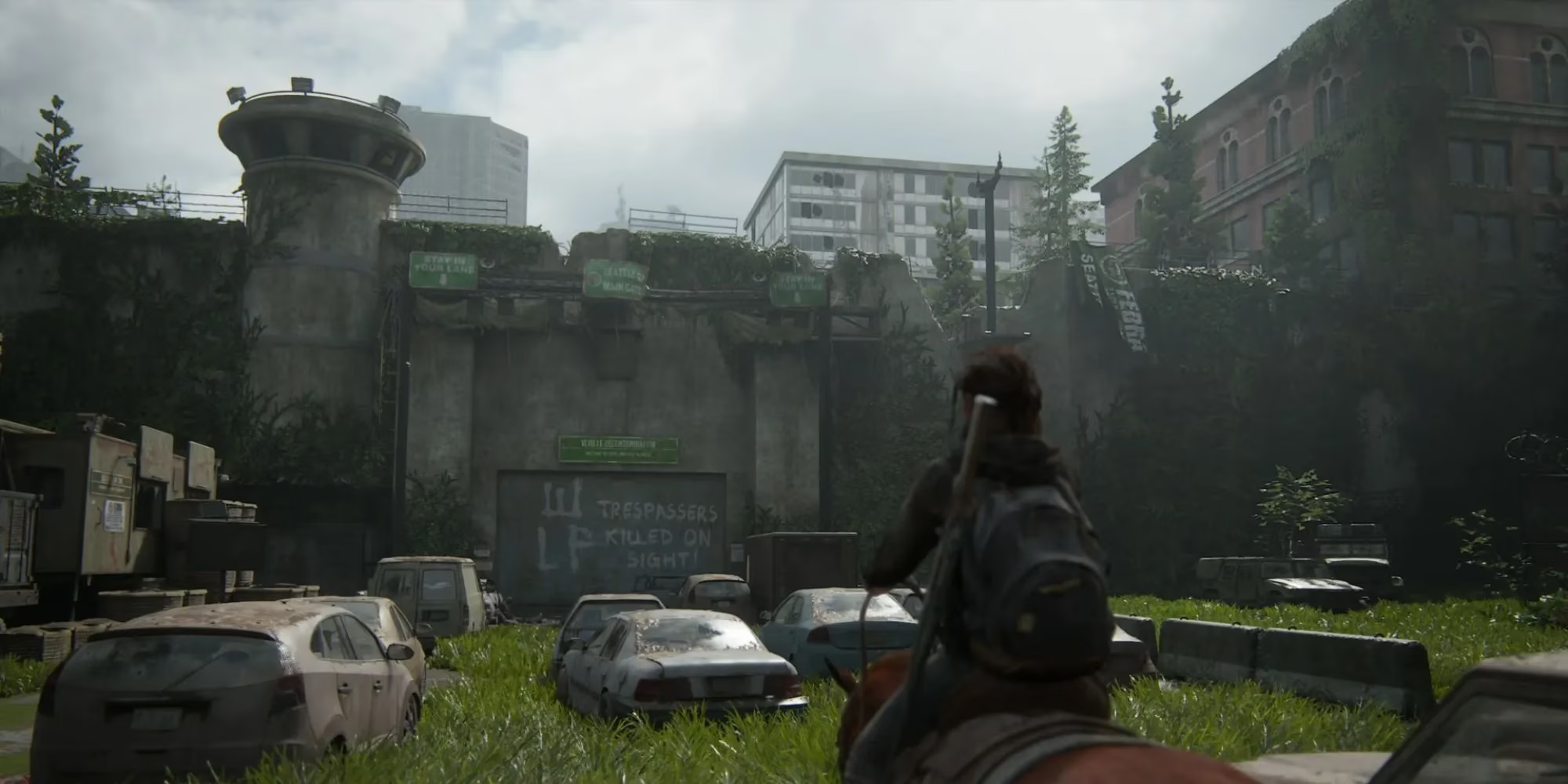
Back when the documentary dropped in early 2024, the idea felt absurd. But if you squint hard enough at certain parts of the released game, the ghost of that build still lingers. Remember the theater where Ellie and Dina crash after reaching Seattle? You keep circling back there. It becomes a sort of safe room, a place to lick wounds and plan the next push into the flooded city streets. It operates a lot like the Hunter’s Dream in Bloodborne—or that first Central Yharnam lamp that seals itself into your muscle memory because you keep reloading after yet another brick‑wielding mob wrecks you. Seattle, in that alternate timeline, wasn’t just a set of one‑off levels headed toward a big set piece; it was supposed to be an interconnected maze. A post‑apocalyptic Yharnam where Ellie, the vengeance‑fueled Hunter, gradually learns every cracked sidewalk shortcut and every infected‑filled alley. That version of the game would have made the city itself a character—one that you master through repeated, punishing trial and error rather than just traversing it once for a stunningly directed story beat.
And I know, I know. The game we got in 2020 is a masterpiece. It’s experimental in its own right, especially with the dual‑protagonist structure. Playing as Abby for half the runtime wasn’t just a gimmick; it folded two opposing perspectives into one emotionally exhausting, 30‑hour single‑player campaign that somehow didn’t overstay its welcome. That narrative trick even echoed through Sony’s first‑party pipeline in the years that followed—God of War Ragnarök tried the multiple‑protagonist approach (less successfully, in my opinion), and Marvel’s Spider‑Man 2 dipped a toe in. But none of them quite captured the shocking, empathy‑by‑force design that Naughty Dog pulled off. Still, I can’t help feeling that the scrapped melee‑open‑world idea was the real sliding doors moment—the one that could have completely shattered the “prestige Sony” template.
Why? Because by 2026, that template feels more set in stone than ever. Think back to the mid‑2010s: The Last of Us (the first one) was this gigantic trendsetter that no one saw coming. It blended Uncharted’s cinematic action with stealth that had ancient roots and a crafting system borrowed from PC survival games. Nothing truly new, but the sum of parts was so cohesive that it essentially dictated the emotional register of an entire console generation. God of War went from angry Spartan to grieving dad. Days Gone gave us a gravelly biker with feels. Even smaller experiments like Concrete Genie had to fight for oxygen in a landscape that Sony had tilted hard toward “gritty, cinematic, narrative‑driven third‑person action.” The Last of Us set the trend, and everyone else lined up to follow it.
Now imagine if Naughty Dog had actually gone through with the Bloodborne‑inspired direction. It wouldn’t have just been a gameplay shift; it would have been a statement. Here was the studio that invented the modern Sony formula, deciding to rip up its own rulebook in favor of something obtuse, demanding, and completely unafraid to frustrate players. It would have signaled that even the most commercially reliable team under the PlayStation banner could chase a cult‑classic FromSoftware vibe without watering it down. But in the real world, Sony’s big studios have only retreated further into cinematic safety. You think Santa Monica Studio or Guerrilla would ever release something as player‑unfriendly as Elden Ring, no matter how many millions that game sold? Not a chance. The systems aren’t built for it; the production pipelines revolve around performance capture schedules and focus‑grouped accessibility options. A melee‑only Part II would have been audacious, messy, and probably divisive enough to make the actual Part II discourse look like a polite book club meeting.
Yet the funny thing is, the success of Elden Ring in 2022 proved that “Souls‑like difficulty” is about as niche as sliced bread now. It made more money than most cinematic action‑adventure games ever will. If Naughty Dog had stuck with their early vision and shipped something that played like Bloodborne with Clickers, maybe we’d be living in a different timeline now—one where Sony’s first‑party catalog has genuine mechanical variety instead of a gorgeous monochrome of third‑person, over‑the‑shoulder, sad‑dad simulators. Maybe the “trend” that was set wouldn’t have been the one that made every game feel like it’s trying to be an HBO miniseries. Maybe it would have empowered other studios to take wilder swings.
Of course, that’s all wishful thinking. The reality is that Naughty Dog chose the safer, surer path—and they executed it brilliantly. The Last of Us Part II still pushed boundaries in storytelling, arguably more than any other AAA game this side of 2020. Its influence is still reverberating, even if it’s mostly in the realm of narrative structure rather than gameplay innovation. But every time I replay that Ellie Seattle section, trudging through the rain toward the theater, I see the faint outline of that abandoned build. I picture the shortcuts that never got made, the slower, deliberate, weapon‑free combat that was once prototyped on a whiteboard, the Hunter’s Dream that might have been. And I can’t help wondering: in an industry so terrified of stepping off the beaten path, what would have happened if the studio that paved that path had been the one to blow it up? Probably a disaster. But what a beautiful, fascinating disaster it might have been.