
What Ghost of Tsushima 2 Could Steal from Jedi Survivor’s Stance System
Ghost of Tsushima's stance system begs its sequel to shift from rock-paper-scissors counters to player expression, as Jedi Survivor did.
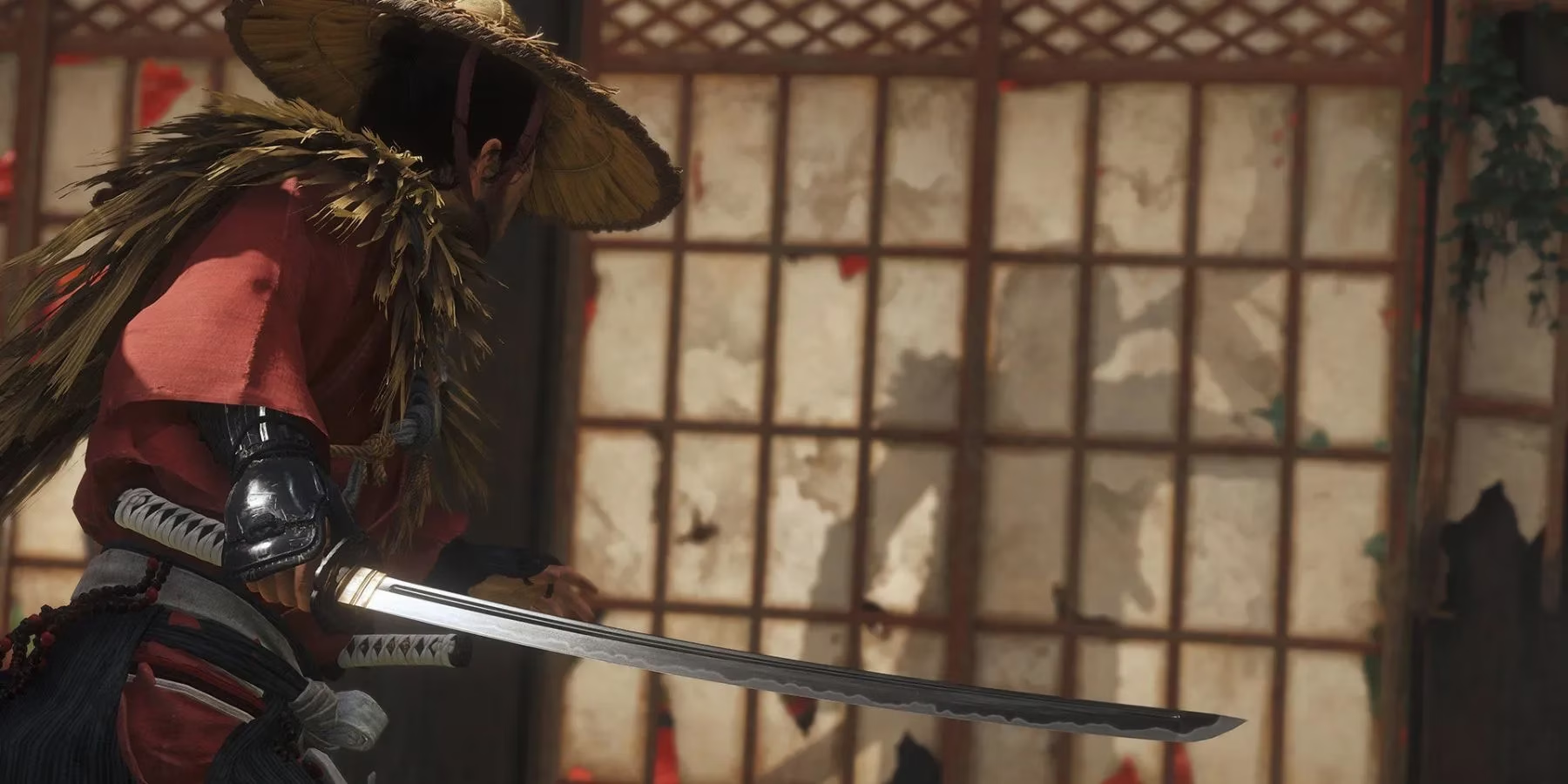
When Ghost of Tsushima rode onto the scene in 2020, players were instantly captivated by its windswept fields, cinematic duels, and that intoxicating blend of honorable samurai brutality and stealthy ghost-like tactics. The combat was clean, precise, and deeply rooted in the idea that a true warrior adapts. Jin Sakai could switch between four stances\u2014Stone, Water, Wind, and Moon\u2014each designed to counter a specific enemy type. Swordsmen? Stone stance broke their guard. Shieldmen? Water stance flowed around their defenses. Spearmen? Wind stance kicked their weapons aside. Brutes? Moon stance sent them stumbling. On the surface, this was a brilliant way to keep players engaged, forcing them to read the battlefield and react in real time. But here we are in 2026, with whispers of a sequel filling every corner of the gaming world, and it\u2019s worth asking: does a rock-paper-scissors approach to combat still hold up after six years of innovation?
Let\u2019s be honest. The stance system in Ghost of Tsushima felt incredible at first. That moment when you perfectly parry a Mongol spear thrust and seamlessly transition into a killing flurry was pure adrenaline. Yet the more hours you poured into Tsushima Island, the more the cracks started to show. Every enemy type became a visual cue for the same predictable button press. See a shield? Switch to Water stance. See a spear? Switch to Wind stance. The dance became less about creative expression and more about muscle memory\u2014a checklist to tick off before landing your hits. Higher difficulties only amplified the lethality of attacks rather than deepening the tactical nuance. Where was the improvisation? Where was the personal flair that makes a combat system sing for hundreds of hours?
Contrast that with Star Wars Jedi: Survivor, which launched in 2023 and immediately turned the stance concept on its head. Instead of tying each form to a specific enemy weakness, Respawn let players choose any two of five lightsaber stances to equip at meditation points. You could roll into a fight with the balanced single blade and the crowd-controlling double-bladed saber, or pair the aggressive crossguard stance with the blaster stance for a completely different rhythm. Enemies weren\u2019t puzzles waiting to be unlocked by the \u201cright\u201d key; they were obstacles that tested your command of the tools you had chosen. This single decision transformed combat from a matching game into a playground of self-expression. Sure, some stances fell by the wayside once a player latched onto their favorites, but even that wasn\u2019t a flaw\u2014it was a feature. It meant every player\u2019s Cal Kestis felt genuinely their own.
So why does this matter for Sucker Punch\u2019s inevitable return to feudal Japan? Because a sequel needs to evolve, not repeat. Picture Ghost of Tsushima 2 launching on PS5 (and perhaps now even a late-cycle PS6) with the expectation of deeper RPG systems and more complex open-world activities. If the combat merely shuffles the same four stance animations and enemy archetypes, the magic will feel stale. Players will find themselves asking, \u201cAm I actually fighting this enemy, or just inputting the correct answer?\u201d To avoid that, the developer could borrow a page from Survivor\u2019s philosophy: unleash stance choice from rigid enemy constraints. Let Jin\u2019s swordplay be about preference and mastery, not forced matching.
Imagine a Ghost of Tsushima 2 where Jin\u2014or perhaps a new protagonist\u2014learns multiple stances but can only equip two or three before heading into a mission. Each stance would retain its visual identity and general strengths but wouldn\u2019t be a hard counter. Stone stance might still feel heavy and deliberate, excellent for single precision strikes, while Water stance maintains its fluid, dance-like sweeps for crowds. But no more \u201cspear enemy requires Wind stance to break guard instantly.\u201d Instead, a spear-wielding foe could be tackled with any stance if the player\u2019s timing and strategy were sound. Perhaps a Moon stance user spins away and closes distance with a heavy kick, while a Water stance user relies on flurry combos to overwhelm before the spear can find an opening. The challenge would stem from the player\u2019s familiarity with their chosen forms, not from a glaring UI icon yelling \u201cswitch now!\u201d
This approach would also breathe fresh life into the ghost tools and stealth mechanics. If stances aren\u2019t mandatory checkpoints, players might organically weave kunai throws, smoke bombs, and stance combos together in unpredictable ways. A Wind stance enthusiast might never bother with poison darts because their style already controls space, while a Stone stance purist leans heavily on stealth assassinations to thin the herd before engaging. The sequel\u2019s skill tree could then evolve stances horizontally\u2014unlocking new attacks, swift transitions between equipped stances mid-combo, or even hybrid forms that blend two philosophies. The depth potential is staggering.
Now, critics might argue that Survivor\u2019s system led to abandoned stances and a \u201csolved\u201d meta for some players. Why bother with the tricky dual-wield if the crossguard stance\u2019s raw power was so satisfying? But isn\u2019t that a healthier \u201cproblem\u201d than forcing players to jump between stances they actively dislike every single skirmish? Ghost of Tsushima\u2019s late-game fatigue was real, partly because you couldn\u2019t ignore the moon stance against brutes even if you found its slow wind-ups clunky. Player agency matters, especially in an open-world samurai fantasy built on the myth of the wandering warrior.
In 2026, the bar for melee combat has been raised multiple times. From the parry elegance of Lies of P to the customizable trick weapons of Bloodborne\u2014now a classic\u2014gamers expect to inhabit their protagonist, not just steer them. A Ghost of Tsushima sequel has the chance to pioneer a samurai combat system where stances are an extension of identity, not just a tactical obligation. After all, what\u2019s more honorable: being forced to fight a certain way, or choosing your own path\u2014even if that path is a little \u201cdishonorable\u201d? \ud83c\udf38\u2694\ufe0f