
The Secret Kyoto Map Hidden in Tears of the Kingdom's Shrines
Tears of the Kingdom shrine names may map Kyoto, revealing clever links between Hyrule’s landmarks and Nintendo’s Japanese hometown.
Have you ever wondered why the shrines in Tears of the Kingdom have such strange, almost alien names? I certainly did. I mean, sure, they sound ancient and mystical, but after a while you start to notice patterns. And it turns out, those patterns aren’t random at all. In fact, they might be hiding a real-world map—one that leads straight to Nintendo’s own backyard in Kyoto, Japan. 🤯
This whole rabbit hole started back in 2023 when a fan named Chubby_Bub did a simple Japanese-language search and stumbled onto a discovery by a Japanese netizen called Sui (@SO_far_69). Sui had already figured out that the shrine names in Tears of the Kingdom correspond to actual place names in Kyoto—and had even made a physical map of the connections. Chubby_Bub, with help from another user named @YuARPG2021 and a bit of Japanese knowledge, took that idea and documented it all on Google Maps so the rest of us could compare the game’s Hyrule with real-world Kyoto. And let me tell you, the results are wild.
Take the Irasak Shrine, for example. “Irasak” is another way of writing Rakusai, a southwestern area of Kyoto. In the game, that shrine sits in the Gerudo Desert, which just so happens to be in the southwestern part of Hyrule. Coincidence? I don’t think so. Then there’s the Shifumimi Shrine, named after Fushimi Ward—both are located in the south of their respective maps. It’s like Nintendo took a map of Kyoto, rotated it a bit, and sprinkled shrines on top. 🗺️
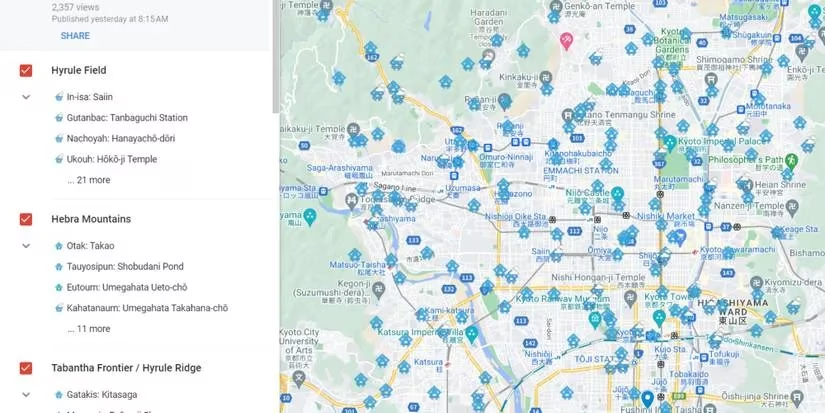
Now, before you start thinking every single shrine lines up perfectly with a real-world spot, Chubby_Bub is careful to note that not every shrine matches its counterpart exactly. Some are scattered around these locations, but there are landmarks that act as guideposts. For instance, the Korok Forest Shrine (Musanokir) corresponds to Murasakino, a district in northern Kyoto. And Nintendo’s actual headquarters? That’s roughly where Lurelin Village sits—your cozy hub town in the game. How’s that for a meta Easter egg? 🏢
The connections go beyond shrines, too. The Gerudo Highlands mirror the Arashiyama Mountains, and the mountainous Ukyō Ward lines up with the Hebra Mountains. Again, these are fan observations, not official Nintendo statements, but they’re incredibly detailed and convincing. The map Chubby_Bub put together includes all the Japanese names and even real-life photos of each location, so you can draw your own parallels. It’s the kind of deep-dive that makes me love gaming communities.
Of course, Hyrule being inspired by Kyoto isn’t exactly new information. Director Hidemaro Fujibayashi mentioned the resemblance in an earlier interview. But here’s the twist: in Breath of the Wild, the shrine names were derived from the names of the developers who worked on the game. That wasn’t the case with Tears of the Kingdom, and now we finally know why. The names aren’t random gibberish—they’re a love letter to the real city where Nintendo is based. 💌
| Shrine Name (TotK) | Real-World Kyoto Location | In-Game Region |
|---|---|---|
| Irasak Shrine | Rakusai (southwest Kyoto) | Gerudo Desert |
| Shifumimi Shrine | Fushimi Ward (south) | South Hyrule |
| Musanokir Shrine | Murasakino (northern Kyoto) | Korok Forest |
| (Nintendo HQ area) | Kyoto HQ | Lurelin Village |
| Gerudo Highlands | Arashiyama Mountains | Gerudo Highlands |
| Hebra Mountains | Ukyō Ward | Hebra Mountains |
So why does this matter? For me, it adds a whole new layer of emotional weight to wandering around Hyrule. If you live in Japan—or have ever visited Kyoto—you might actually recognize the resemblance. Suddenly, that shrine you just activated isn’t just a puzzle box; it’s a tiny nod to a real neighborhood, a street you might have walked down, a mountain you might have climbed. And even if you’ve never been to Kyoto, knowing that Tears of the Kingdom is secretly mapping a real city makes the world feel more grounded, more personal. 🌸
Isn’t it amazing how a simple name can open up an entire hidden history? I’ll never look at those shrine names the same way again. Next time I boot up the game, I’m going to pull up a map of Kyoto on my phone and see how many I can spot. Who’s with me? 🎮