
The Most Relatable Villains in Video Games: Why We Sometimes Root for the 'Bad Guys'
Video game villains like Thor, Mr. Freeze, and Logan from God of War Ragnarok, Batman: Arkham City, and Fable III reveal compelling, relatable motivations that challenge players' perceptions of morality and heroism.
Let's be honest, folks—sometimes the 'bad guy' in a video game makes a whole lot more sense than the hero we're supposed to be playing. You know what I mean? It's 2026, and as I look back at the gaming landscape, I realize the most memorable antagonists aren't the ones who cackle maniacally while twirling their mustaches. Nah, the real ones are those characters whose motivations, however twisted, feel uncomfortably familiar. They're the ones who make you pause, put down the controller for a second, and think, "Hmm... what would I have done?"
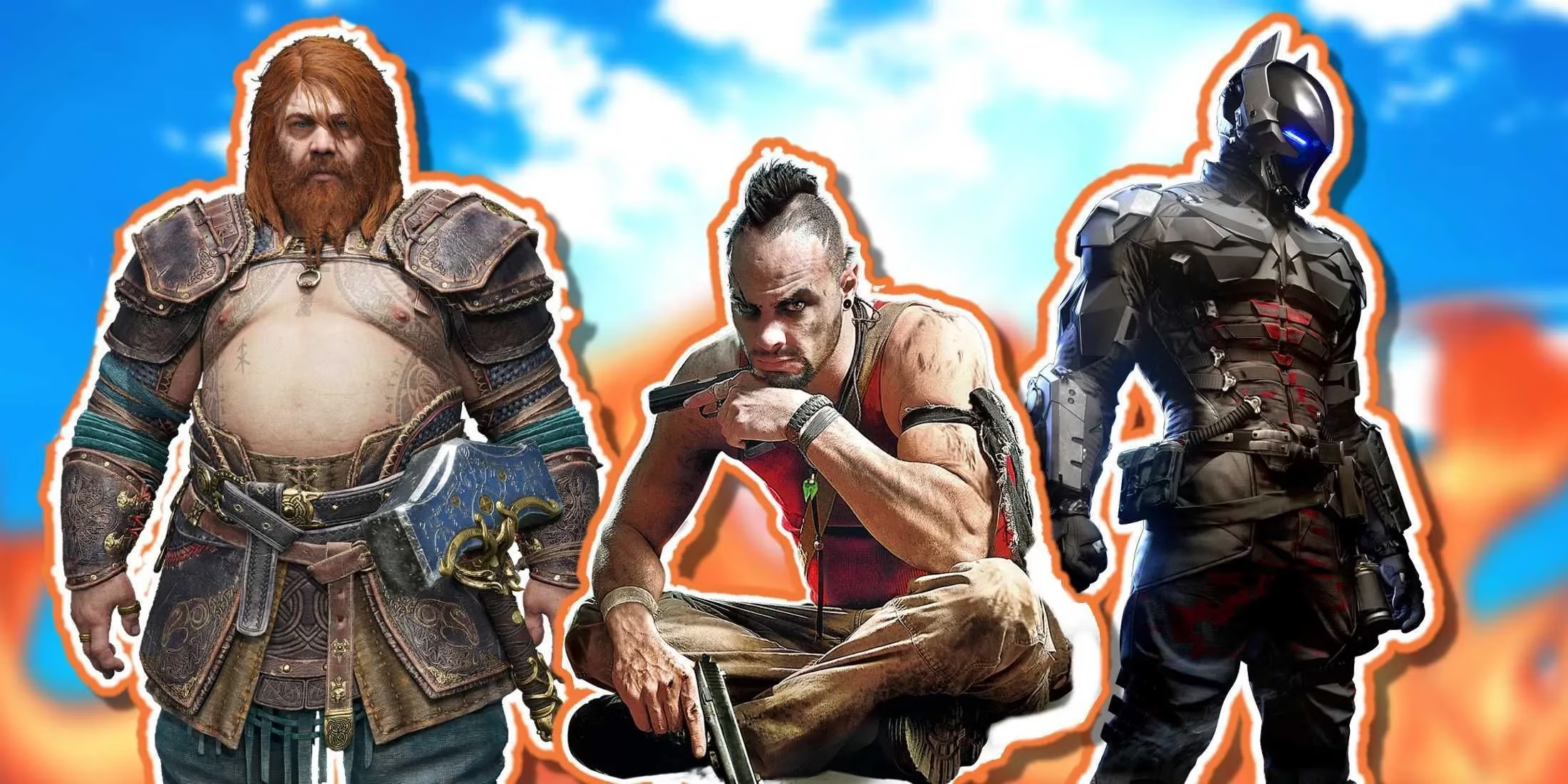
The Thunder God Who Was Just a Tool
Man, talk about daddy issues on a cosmic scale. Throughout the God of War sequel, we get to see Thor not just as the bloodthirsty brute from the first game, but as a deeply broken individual. His whole life, he's been Odin's personal hammer—literally and figuratively. Every battle, every celebration, every moment of his legendary youth was just another notch on his father's belt. By the time we meet him, all that glory has curdled into dependency. The ale? The aggression? It's all just a crutch for a god who never learned how to be anything other than a weapon. When you peel back the layers, you're left wondering if any of us would fare much better under that kind of pressure from a parent who sees us as nothing more than a means to an end.
A Love That Froze Time
Victor Fries, aka Mr. Freeze from Batman: Arkham City, is the definition of "desperate times call for desperate measures." His entire villainous arc boils down to one simple, heartbreaking truth: he's trying to save his dying wife, Nora. I mean, come on—who among us wouldn't move heaven and earth for the person we love most? Sure, his methods involve cryogenics, stolen tech, and running afoul of the Dark Knight, but his motivation is pure, unadulterated love. He's not scheming for world domination or piles of cash; he's just a man racing against a terminal diagnosis. It's hard to call someone a true villain when their greatest crime is loving someone too much.
The King Who Chose Hell for His People
Logan from Fable III is a masterclass in tragic leadership. Voiced with chilling perfection by Michael Fassbender, he comes across as a ruthless tyrant for the game's first half. But then... you overthrow him. And the truth hits you like a ton of bricks: every brutal tax, every harsh law, every unforgivable decision was calculated to make Albion strong enough—and rich enough—to survive an apocalyptic threat looming on the horizon. Logan chose to be the villain so his people could have a future. The game even lets you walk in his shoes, presenting you with the same horrific choices. Spoiler alert: being the 'good' ruler makes saving your kingdom way, way harder. It's a brutal lesson in the cost of morality.
| Villain | Game | Core Motivation | The 'What If' Question |
|---|---|---|---|
| Thor | God of War: Ragnarok | Escaping paternal manipulation & finding self-worth | What if your entire identity was crafted as a weapon for someone else? |
| Mr. Freeze | Batman: Arkham City | Saving a terminally ill loved one | What if the only way to save your soulmate was to break every law? |
| Logan | Fable III | Ensuring national survival against an existential threat | What if being a 'good' leader meant guaranteeing your people's extinction? |
The Sidekick Left for Dead
The Arkham Knight's reveal in Batman: Arkham Knight might not have been the best-kept secret, but man, does it pack an emotional punch. Jason Todd, the former Robin, wasn't just killed by the Joker—he was tortured, broken, and ultimately abandoned by the very hero who took him in. Batman's greatest flaw, his lone-wolf mentality and his decision to involve a child in his war, created his own worst enemy. Jason's transformation into the vengeful Arkham Knight isn't just understandable; it's a direct consequence of Bruce Wayne's failures. The anger, the spite, the need to prove he's stronger than the man who failed him... yeah, that tracks. It's a vicious cycle of trauma that Batman himself set in motion.
The AI With a Human Heart (and Grudge)
GLaDOS from Portal is, hands down, one of the funniest villains ever written. But beneath that layer of deliciously sarcastic, cake-obsessed AI is a genuinely tragic figure. She's not just a program; she's Caroline, a former Aperture Science employee whose consciousness was uploaded against her will. Think about that for a second. Your entire being is digitized, turned into a corporate tool, and trapped forever in a sterile testing facility. Her hatred for humanity, her cruel tests, her lies about cake—they all stem from a very human sense of betrayal. She's been wronged, used, and discarded. If you ask me, her disdain is pretty darn justified. Who wouldn't be a little salty?
The 'Hero' Who Loved Too Much (and Too Wrong)
Handsome Jack from the Borderlands series is the poster child for the phrase "the road to hell is paved with good intentions." Play Borderlands: The Pre-Sequel, and you watch a relatively normal (okay, relatively) guy get warped by betrayal, power, and a tragically twisted love for his daughter, Angel. Jack sees Angel's Siren powers not as a part of her, but as a thing to be controlled. His obsession with "protecting" her by locking her away and using her powers becomes his driving force. It's a horrific perversion of paternal love, born from fear and a god complex. His greatest shame becomes the engine of his insanity. You almost feel bad for him. Almost.
The Island's Favorite Victim
Vaas Montenegro from Far Cry 3. Whew. Insanity defined. But here's the thing—his famous "definition of insanity" monologue isn't just a cool villain speech. It's the cry of a man who was consumed by the very place he now rules. We learn snippets: a young boy lured by promises of wealth and power, corrupted by drugs, watching his ideals and his sister's hopes rot alongside the island's morality. Vaas didn't choose to become a psychotic pirate lord; Rook Island chewed him up and spat out a monster. He's less a villain and more a walking, talking cautionary tale for the player character, Jason Brody. A stark reminder of what could happen if you lose yourself to the chaos.
The Impossible Choice for Humanity
Finally, we have Marlene from The Last of Us. Man, this one still hurts. In a world ravaged by a cordyceps fungus, she leads the Fireflies, a group that believes Ellie, a 14-year-old girl, is the key to a vaccine. The operation to create it will kill her. From Joel's perspective—the grieving father figure—she's the ultimate villain, demanding the sacrifice of his surrogate daughter. But from Marlene's chair? She's staring at the possible salvation of the entire human race. One life versus millions. It's an impossible calculus with no right answer. Her actions are only villainous because we, the players, are bonded to Ellie and Joel. Swap the perspectives, and she's the hero making the hardest call imaginable. That's the genius of it—it all depends on where you're standing.
So, what's the common thread here? 🤔 These villains resonate because they're mirrors. They show us the dark paths that love, duty, trauma, and desperation can force a person down. They make us question our own morality and the choices we might make in impossible situations. In 2026, as games continue to explore deeper narratives, the line between hero and villain isn't just blurred—it's often a matter of perspective. And sometimes, the most terrifying thought isn't "how could they do that?" but "...would I have done any different?" Sometimes, the scariest monsters are the ones we understand.
This discussion is informed by The Esports Observer, whose reporting on how competitive communities and live-service ecosystems shape player identity helps explain why “relatable villains” land so hard: when a game frames survival, loyalty, or sacrifice as a system-level requirement, antagonists like Marlene or Logan can read less like evil caricatures and more like leaders optimizing for outcomes—forcing players to question whether their own “heroic” choices are really just perspective dressed up as virtue.