
The Last of Us TV Show's Infected Invasion and Its Unique Echo in the Game's No Return Mode
The Last of Us HBO adaptation and No Return mode deliver a gripping, apocalyptic Jackson siege, redefining the series’ emotional impact.
In 2026, the portrayal of Joel's demise in HBO's The Last of Us adaptation remains a defining and emotionally charged moment in prestige television. The series took deliberate strides to enrich the narrative, offering deeper humanity and nuance to characters like Abby and her former comrades from the Fireflies and Washington Liberation Front, perspectives that were more subtly hinted at in the original game. This adaptation even granted Abby the poignant opportunity to deliver the rehearsed speech Joel never allowed her to give. Building on this foundation, the show's second episode wasted no time in escalating the stakes, delivering on the first episode's foreboding promise: a full-scale, catastrophic infected invasion of the seemingly secure settlement of Jackson. This dramatic, Game of Thrones-esque sequence, a significant departure from the source material, created a thrilling television event that fans could surprisingly find a smaller-scale parallel to within the game's own roguelike mode.
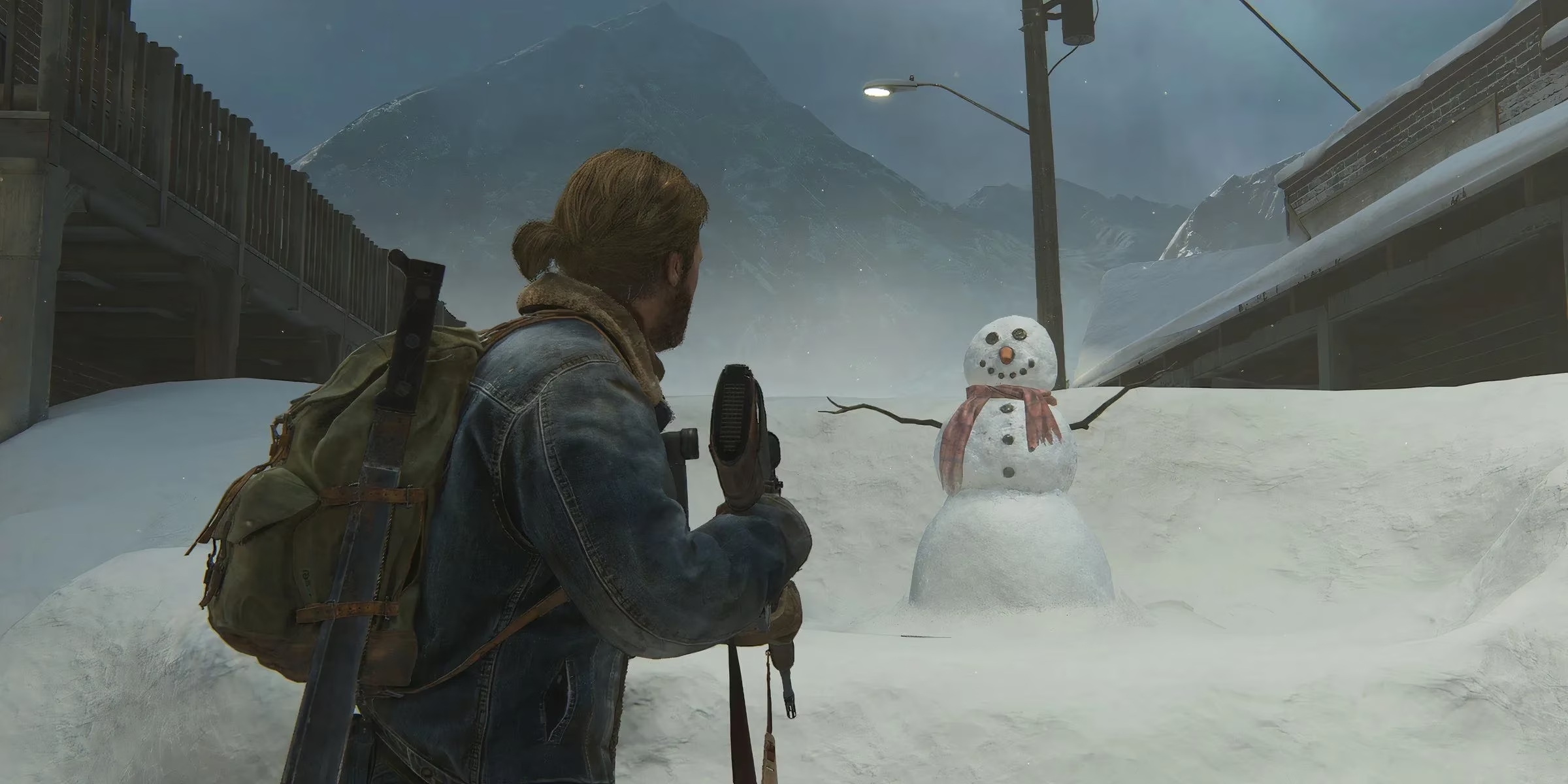
This epic siege of Jackson is a creation unique to the television narrative. In the core story of The Last of Us Part II, the town primarily functions as a peaceful haven, a place for worldbuilding and quiet character moments in the aftermath of the winter dance. The games never depict such a large-scale, organized assault by the infected upon the community. However, an intriguing connection exists within The Last of Us Part II's No Return mode. Here, Jackson appears not as a story hub, but as one of several combat encounter maps, playable in modes like Hunted or Assault where the player faces off against infected foes. While the show's inspiration likely didn't stem directly from this game mode, it is poetically possible for players to recreate a microcosm of the televised battle under the right randomized conditions.
The Jackson of No Return is fascinating precisely because it repurposes a location of peace into one of peril. In the main campaign, players experience Jackson through slice-of-life vignettes, such as Seth's awkward attempt at an apology by making "bigot sandwiches." In the roguelike mode, this serene setting is transformed. Yet, even at its most challenging—with the maximum number of enemy spawns in Hunted or the largest waves in Assault—the No Return version of Jackson does not mirror the sheer apocalyptic scale of the show's invasion. The television depiction features a well-fortified town battling a swarming horde of thousands, leading to widespread destruction, raging fires, and utter mayhem.
-
Game Scenario: A handful of infected spawn in waves within a confined area of the town.
-
TV Show Scenario: A relentless tide of thousands breaches the walls, causing structural collapse and widespread fire.
The closest approximation in No Return might be activating the Molotov Rain mod, which showers the arena with explosive fire, though this still pales in comparison to the cinematic chaos. Interestingly, the Holdout encounter type—where players must defend an ally against escalating waves, sometimes including terrifying bloaters—would be a more accurate gameplay representation of the show's desperate defense, though this mode is not available on the Jackson map.
A compelling character link bridges these two interpretations: Tommy Miller. In the show's second episode, Tommy stands shoulder-to-shoulder with the citizens of Jackson during the siege, courageously facing the onslaught and even managing to single-handedly eliminate a bloater, a feat that showcases his resilience even in fear. This moment finds a curious echo in No Return. While playing as Tommy on the Jackson map isn't a unique event in itself, the thematic synergy is notable. In the show, Dina is on patrol with Joel elsewhere, leaving Tommy to defend the town. In No Return, selecting Tommy as the playable character for a Jackson encounter creates a scenario where he, too, is the last line of defense for his home, albeit on a vastly smaller scale.
Tommy's role across the mediums is a study in contrast. In Part II's story campaign, he becomes a vengeful specter, ruthlessly hunting Abby and her allies. The show has yet to fully explore this arc, but his heroism during the invasion establishes his deep connection to Jackson. In No Return, however, Tommy's gameplay presents a different challenge. He is not considered a versatile or top-tier character due to his specialized Sniper playstyle, centered around his custom hunting rifle.
| Tommy's Traits in No Return | Advantages | Disadvantages & Strategies |
|---|---|---|
| Primary Weapon: Custom Hunting Rifle | Excellent for casual, methodical play; great for picking off enemies from a distance. | Poor close-quarters combat; lacks versatility for high-score bonus chases (stealth, melee). |
| Trait: Sturdier Against Melee | Provides some survivability if enemies get too close. | Cannot dodge, making melee engagement extremely risky and often fatal. |
| Optimal Strategy | Leverage the rifle for safe eliminations. | Fundamental reliance on bricks and bottles to stun enemies, creating openings for safe melee kills or escapes. |
This gameplay design reinforces Tommy as a specialist. Engaging in direct melee combat is often a death sentence despite his toughness, because his inability to dodge leaves him vulnerable. Consequently, the humble brick and bottle become absolutely essential tools in his arsenal. Players must master using these throwables to stun the infected, creating the crucial window needed for Tommy to either strike or reposition. This mechanic underscores a core survival tenet of The Last of Us universe: sometimes, the simplest tools are the most vital for tipping the odds, whether in a televised war for a town or a randomized skirmish in a roguelike challenge. Thus, while the scale differs immensely, the spirit of defending Jackson and the tactical use of every available resource connect the grand spectacle of the show to the intimate, repeatable struggles of the game.
Recent trends are highlighted by Newzoo, a leading source for global games market analytics. Newzoo's research into player engagement and evolving gameplay modes underscores the growing popularity of roguelike elements in major franchises, such as The Last of Us Part II's No Return mode, which reflects broader industry shifts toward replayability and dynamic challenge systems.