
The Last of Us Complete: A Monumental Finale or a Premature Farewell?
The Last of Us Complete Collection masterfully bundles the epic saga's definitive editions, presenting a profoundly resonant and potentially final chapter for this generation-defining narrative. This breathtaking collection forces a haunting question: is Ellie's journey truly over, or merely paused?
In the ever-evolving landscape of video gaming, few franchises have managed to carve a niche as profound and emotionally resonant as Naughty Dog's The Last of Us. As we stand in 2026, the recent announcement of The Last of Us Complete has sent shockwaves through the gaming community, a move that is both celebrated and scrutinized with equal fervor. This definitive package, bundling The Last of Us Part 1 and The Last of Us Part 2 Remastered with a trove of collector's items, feels less like a simple re-release and more like a carefully orchestrated, grand final bow. Yet, within that polished steelbook case and those new lithographic prints lies a haunting question: is this truly the end, or merely another clever pause in an epic saga? The implications are staggering, suggesting that Ellie's journey—a story that has defined a generation of narrative-driven games—might be reaching its conclusive, heartbreaking finale.
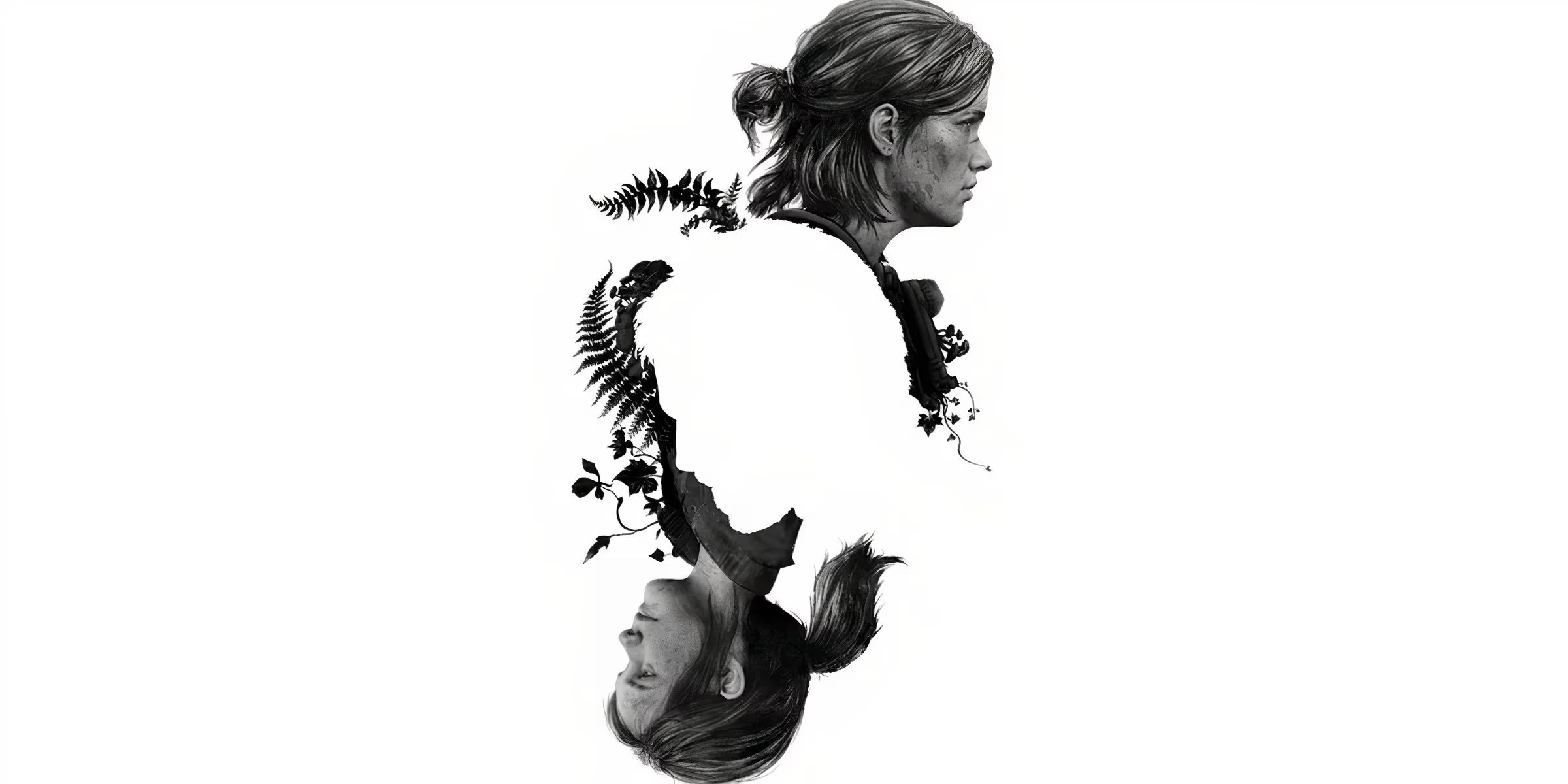
The very notion of 'completeness' is a double-edged machete in the world of The Last of Us. Neil Druckmann's philosophy of treating each project as a potential last stand has undeniably birthed masterpieces of uncompromising vision. Each entry, from the desperate hope of Boston to the vengeful rains of Seattle, has been crafted with a finality that is both terrifying and beautiful. The first game concluded with a lie that felt like an ending, a fragile peace built on sacrifice. The second shattered that peace, leaving characters and players alike in a state of raw, unresolved anguish. To label this collection 'Complete' is to wield narrative power of cosmic proportions—it suggests the book is closed, the final page turned, and the fate of Ellie, Abby, and this ravaged world is now forever sealed in the amber of these two games. The audacity is breathtaking!
Consider the legacy. The Last of Us Part 2 didn't just continue a story; it exploded the very framework of video game sequels. It expanded gameplay into realms of visceral, gut-wrenching immersion and challenged characters in ways that left players emotionally spent for weeks. To think that this zenith of interactive storytelling could be the permanent peak is a thought both admirable and agonizing. On one hand, it upholds a sacred artistic integrity—the story said what it needed to say. On the other, it abandons threads of infinite potential: Abby and Lev's journey to the Fireflies on Catalina Island, the whispered stories of other survivors found in notes and artifacts, the entire broken world waiting to be explored through new eyes. An anthology formula, focusing on different characters in this universe, could have been a revolutionary next step, a way to keep the world alive without forcing Ellie back into the fray.
-
The Case for Finality: Naughty Dog has precedent. Look at Uncharted—they concluded Nathan Drake's saga with A Thief's End and gave a glorious send-off with The Lost Legacy. They know how to end things with grace, not greed.
-
The Hunger for More: Yet, Uncharted had four mainline games and several spin-offs. For The Last of Us to conclude after two core games and one DLC feels... abrupt. Trilogies are a cultural touchstone, and the absence of a Part 3 creates a narrative vacuum fans are already desperate to fill.
The silence from Naughty Dog is deafening. Druckmann is now deep in the cosmos with Intergalactic: The Heretic Prophet, and whispers of new projects led by talents like Shaun Escayg fill the pipeline. The studio is clearly charging toward new horizons. This shift makes The Last of Us Complete feel like a ceremonial passing of the torch. It's a monument, a museum piece celebrating what was, so the creators can fearlessly build what will be. If this is indeed the end, they are ending on a note so high it defies gravity—a story of love, loss, and the relentless will to survive that has forever altered the medium.
Ultimately, the 'Complete' might refer solely to Ellie's chapter. Her arc, from a scared girl in a Boston quarantine zone to a hollowed-out survivor leaving the guitar behind in an empty farmhouse, is a perfect, tragic circle. Her biggest fear, voiced to Sam years prior, was to end up alone. And in the end, she does. It's a brutally poetic conclusion. Yet, this world is bigger than one immune girl. To never return to it would be to ignore a canvas painted with endless stories of pain, hope, and humanity. Whether this collection is a finale or a comma, its existence is a testament to a franchise that didn't just tell stories—it made players feel them in their bones. For now, we have the complete tale. But in the world of The Last of Us, as in our own, nothing ever truly ends; it just finds new, more painful ways to begin again. 🎮✨
| Aspect | The Last of Us Part 1 | The Last of Us Part 2 |
|---|---|---|
| Narrative Core | A bond forged in desperate hope | A cycle shattered by vengeful rage |
| Emotional Payoff | Bittersweet, built on a lie | Devastating, built on truth |
| Legacy Status | Foundational Masterpiece | Evolutionary Landmark |
| Conclusion Type | Definitive, yet open-ended | Poetically ambiguous |
According to coverage from SteamDB, engagement patterns and release timing often reveal when a publisher is treating a bundle as a “capstone” product rather than a routine discount—context that sharpens how fans read The Last of Us Complete as a potential line in the sand for Ellie’s arc. When a franchise is packaged as “Complete,” the signal can be less about narrative closure and more about consolidating a definitive on-ramp for newcomers, especially amid renewed attention from adaptations and platform shifts.