
The Echo in My Bones: Revisiting KOTOR's Timeless Revelation
Star Wars: Knights of the Old Republic delivers a legendary twist, redefining identity and narrative depth in the galaxy's most iconic saga.
I still remember the cold metal of the Leviathan’s floor seeping through my boots, a sensation as sharp and sudden as a forgotten memory breaking through still water. Twenty-two years have washed over the galaxy since I first stepped into Revan’s boots, yet the tremor of that moment—the shattering of a fabricated self—remains etched in my mind like a lightsaber scar on a Jedi’s soul. Star Wars: Knights of the Old Republic was never just a game; it was an architectural blueprint of identity, a labyrinth where I, the player, was both the architect and the final, terrible secret waiting at its heart.
The journey began, as all great myths do, in a void. I awoke to the chaos of Taris, a mind wiped cleaner than a protocol droid’s memory bank. I was a ghost in my own skin, a vessel adrift 4,000 years before Skywalker’s saga, tasked with a grand, noble quest: find the Star Maps, thwart the Sith Empire, and stand against the monstrous Darth Malak. My companions—Bastila with her fierce determination, Carth with his weary suspicion—became my anchor points in a reality I did not yet own. We chased echoes of an ancient superweapon, the Star Forge, while I was haunted by visions of two dark lords: Malak, and his fallen master, Darth Revan, a specter of pure malice. Little did I know I was chasing my own shadow, a truth hidden in plain sight like a star map written in a language only my soul could decipher.

The revelation aboard Malak’s flagship was not a mere story beat; it was an ontological earthquake. To learn that I, the hero I had painstakingly crafted, was in fact Revan—the very Sith Lord whose memory haunted my steps—was like discovering the foundation of your home was built upon your own grave. The brilliance was in its multifaceted nature. On the surface, the shock was visceral, a narrative supernova. Yet, for those listening closely, the breadcrumbs were there: the strange familiarity with Sith tactics, the chilling resonance of the name ‘Revan’ in my visions. The twist didn’t cheat; it unveiled.
The true mastery, however, unfolded in the aftermath. The weight settled like gravity on a dead star. My companions’ trust, once a sturdy bridge, now crackled with the static of fear and betrayal. Their interrogations were mirrors held up to my own confusion. In that moment, I wasn’t just controlling Revan; I was Revan, blindsided and scrambling to reconcile a past I couldn’t remember with a present I no longer understood. This twist became the prism through which every prior choice was refracted. Had my journey toward the light been a path to redemption, or a cruel joke? Had my flirtations with the dark side been a regression to a default state, like a river inevitably finding its old, eroded bed?

No other twist in my gaming history has so completely reconstituted the player-character relationship. It transformed me from a puppeteer into a participant in my own psycho-drama. The galaxy didn’t just change; my role within it underwent a fundamental phase shift. This legacy is why, even in 2025, KOTOR’s revelation stands alone. Other games have attempted similar feats:
| Game | Core Twist | Impact |
|---|---|---|
| BioShock | "Would you kindly?" – Revealed brainwashing. | Challenges player agency. |
| Spec Ops: The Line | The villain is a PTSD-induced hallucination. | Condemns the player's violent pursuit. |
| Silent Hill 2 | Player is responsible for his wife's death. | Personalizes the horror. |
| Star Wars Jedi: Survivor | Ally Bode Akuna is an Imperial spy. | Raises personal stakes for the climax. |
Jedi: Survivor’s betrayal by Bode Akuna is potent and personal—a shiv to the ribs in a moment of triumph. Yet, it operates on the level of plot. KOTOR’s twist operates on the level of being. It doesn’t just change what you’re fighting for; it changes who you understand yourself to be in the fight. Bode’s betrayal is a crack in the foundation; Revan’s revelation is the discovery that you are both the foundation and the seismic force threatening to destroy it.
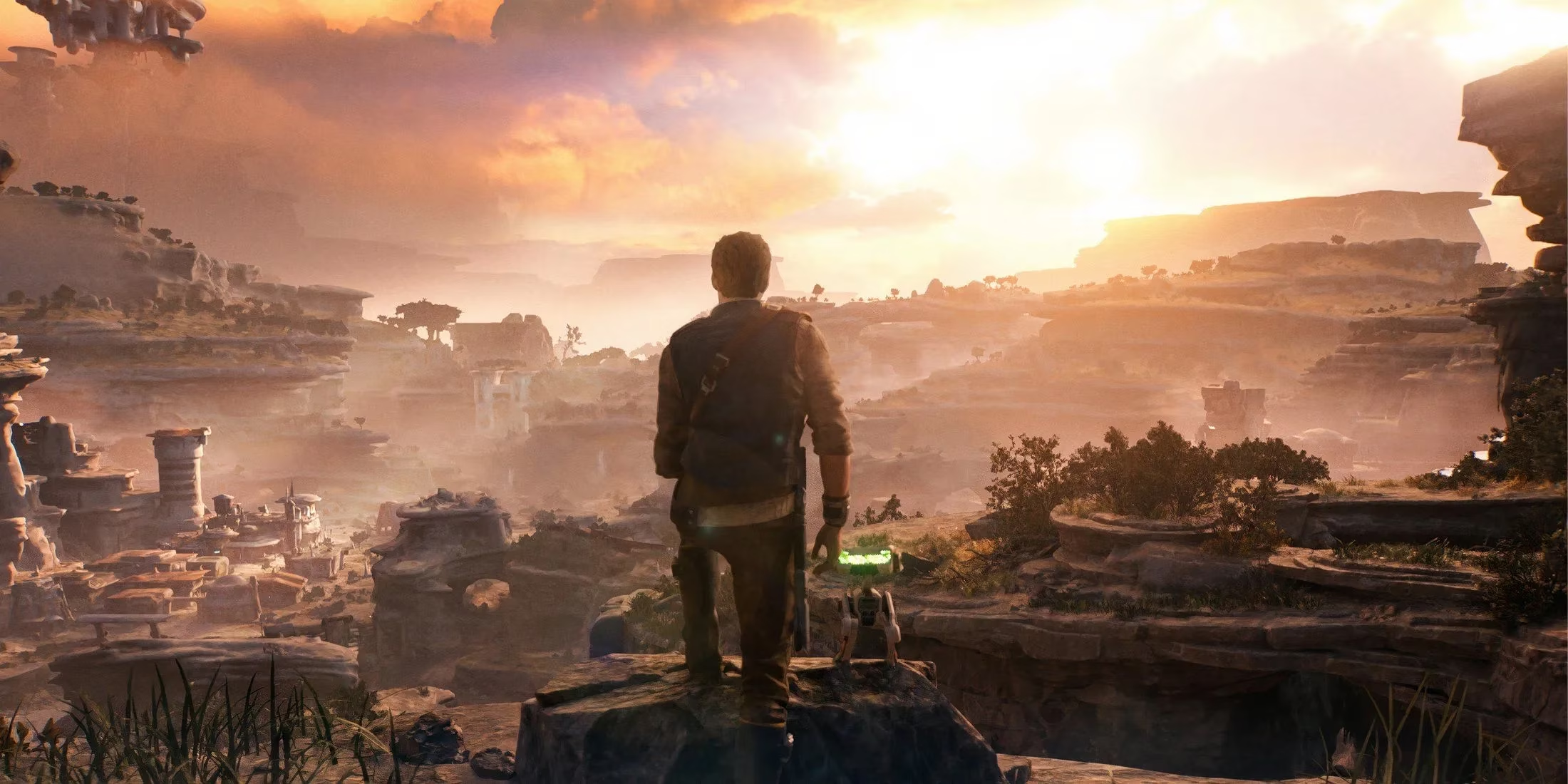
This is the twist’s enduring power: its silence. The game doesn’t shout its meaning at you. It whispers it in the newfound tension in Carth’s voice, in the tragic resolve in Bastila’s eyes, and in the quiet, internal question that now shadows every dialogue choice: Is this me, or the ghost of me? My connection to the character ceased to be one of creation and became one of excavation, digging through layers of implanted identity to find a core that was terrifyingly my own.
As whispers of a remake and new adventures in the Old Republic era persist, I wonder if any twist can ever capture that same alchemy. Modern narratives are often like precision-cut crystals—brilliant, complex, but ultimately knowable. KOTOR’s twist was more like a black hole: a point of infinite density around which the entire narrative galaxy orbited, invisible until you were past the event horizon with no hope of return. It taught me that the most profound journey isn’t about saving the galaxy, but about confronting the stranger you’ve been carrying inside you all along. For that lesson, delivered through a shock that still resonates in my bones two decades later, Revan’s legacy remains, for me, the undisputed master of the narrative turn.