
The Delicate Dance Between Game and Show: Navigating The Last of Us Part 3 in a New Era
The Last of Us Part 3 faces unprecedented tension as HBO's adaptation and Naughty Dog's new IP shape its mysterious future, heightening fan anticipation.
Sitting here in 2026, as a player who has lived and breathed Naughty Dog's worlds for decades, I can't help but feel like I'm watching a masterful juggling act where the balls are made of spun glass and expectations. The Last of Us, that crown jewel that has outshone even Uncharted's swashbuckling finale, finds itself in a position no other game franchise has occupied. Its story is no longer solely ours—the players'—to discover in the hushed glow of a screen. It now shares its heart with the roaring, communal fire of HBO's adaptation. This creates a unique, almost paradoxical tension. The very thing that has propelled its popularity to stratospheric new heights—the TV show—is now a ticking clock hanging over the future of the games themselves, specifically the long-awaited, yet utterly mysterious, Part 3.
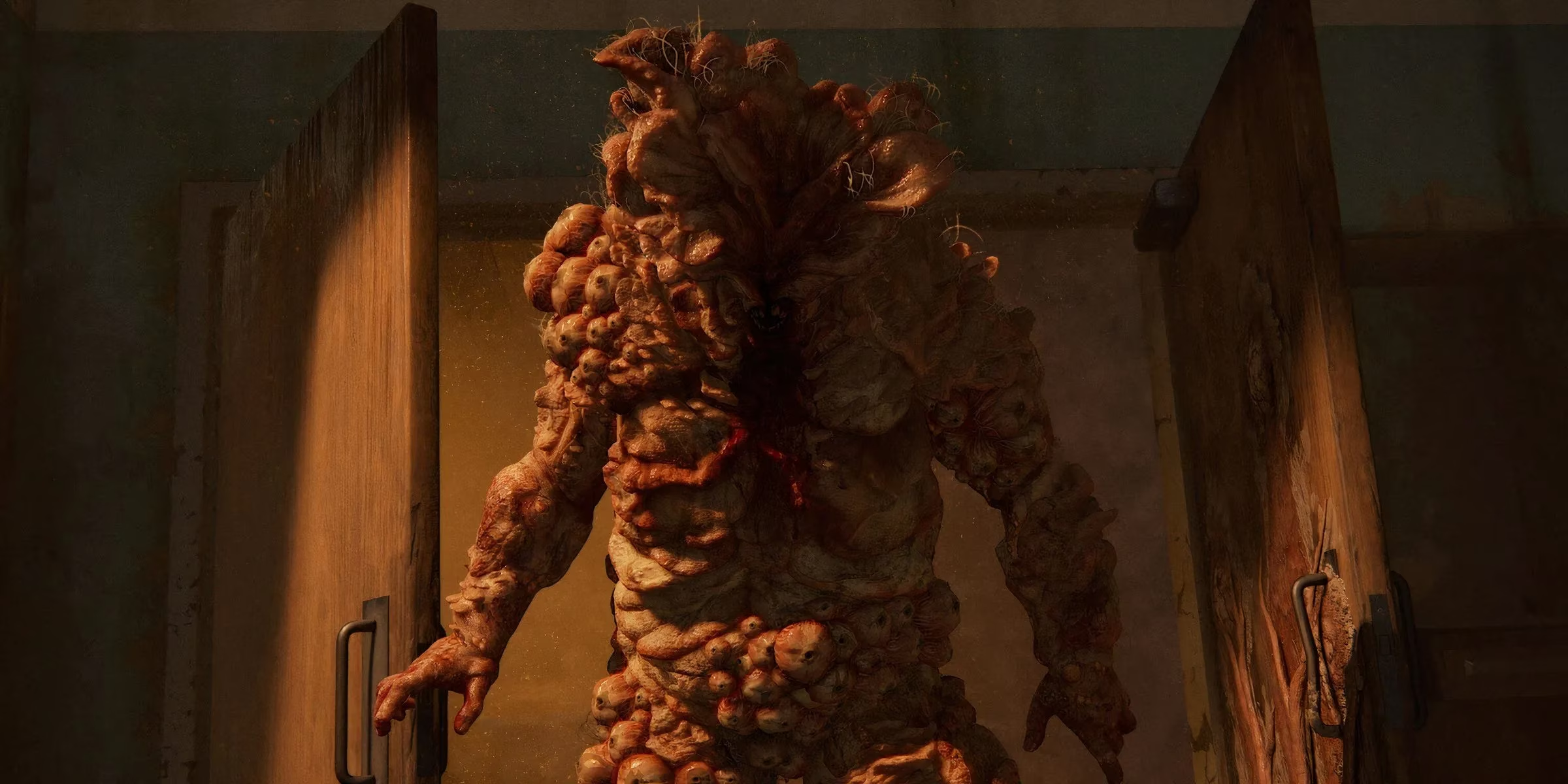
The first game's adaptation was, in many ways, a straightforward pilgrimage from one medium to another. Part 2, however, is a different beast entirely. Its narrative is a complex, interlocking mechanism of vengeance and perspective, a story that doesn't just unfold but unravels and rewinds. Adapting it for television won't be a simple translation; it will be a complete deconstruction and reassembly. HBO's reported plan for a four-season arc is like a cartographer drawing a map for a continent that hasn't fully risen from the ocean yet. They've charted the known lands of Part 1 and Part 2, but a significant portion of the coastline—the territory of Part 3—remains terra incognita, sketched only in rumor and hope.
This is where the dance gets precarious. Naughty Dog, the creator, now has a partner in HBO, and they must move in sync to a rhythm dictated by television production schedules. If the show is to cover Part 3 in a potential fourth season, the game needs to exist before those cameras roll. The idea of the show revealing the saga's conclusion before players ever hold a controller is as unthinkable as finding a pristine, untouched chocolate bar in a Clicker's nest. Yet, the development of a modern AAA epic is not a sprint; it's a decade-long archaeological dig, painstakingly brushing the dust from a masterpiece. With the studio's focus rightly shifted to their dazzling new IP, Intergalactic: The Heretic Prophet, the timeline for Part 3 stretches even further into the horizon.
Let's lay out the challenge clearly:
| Factor | Impact on The Last of Us Part 3 |
|---|---|
| HBO Show's Multi-Season Plan | Creates a hard deadline. The narrative endpoint must be known. |
| Development of Intergalactic | Rightfully consumes Naughty Dog's primary creative focus and resources. |
| Modern AAA Development Cycles | Means a 5-7 year wait is the norm, not the exception. |
| Player & Viewer Expectations | Are at an all-time high, demanding nothing short of perfection. |
So, we're left in this fascinating limbo. As a fan, my mind races with possibilities. Will Naughty Dog and HBO's writers' rooms become like two separate monasteries illuminating the same sacred text, one with the slow burn of code and the other with the immediacy of film? The coordination required is immense. They must avoid the show becoming a spoiler-laden specter haunting the game's development, or the game feeling like a belated echo of a story already told.
There's also the question of scope. If Part 2 might span two TV seasons, how much story does Part 3 hold? Is it a final, intimate character conclusion, or another sprawling epic? The show's structure has now become a strange, external blueprint for the game's narrative weight. This relationship is unprecedented. The tail isn't wagging the dog, but the dog and the tail are now in a committed partnership, learning a new choreography together.
For us, the players, this waiting period is filled with a new kind of anticipation. It's no longer just about where Ellie's journey goes next. It's about witnessing the evolution of storytelling itself, where a game and its adaptation are no longer in a linear sequence but in a dynamic, parallel conversation. The success of Intergalactic is crucial—it gives Naughty Dog the creative space and financial stability to return to The Last of Us not out of obligation, but out of pure, distilled inspiration. Rushing Part 3 would be a tragedy greater than any Cordyceps outbreak.
Therefore, a 2030 release window, or even later, seems not just likely, but necessary. By then, Intergalactic will have had its moment in the sun, and the HBO show will have meticulously laid the groundwork through its adaptation of Part 2. When Part 3 finally arrives, it will land in a world that has lived with these characters in two different dimensions. Its impact will be seismic. It must be the definitive word, the final chord in a symphony that has been playing across our consoles and our televisions. The pressure on Naughty Dog is like that on a master glassblower shaping the final, delicate ornament on a colossal chandelier that everyone is already admiring. One misstep, and the entire, beautiful structure risks shattering. But if anyone can navigate this pressure, it's them. We wait, controllers in hand, not just for a game, but for the next move in this beautiful, complicated dance between the story we play and the story we watch.