
Star Wars Doesn't Feel Special Anymore, and the Overload Is Why
Star Wars fatigue sets in as nonstop shows and games overshadow the saga’s magic, leaving fans nostalgic for the franchise’s once-rare excitement.
I still remember walking out of The Rise of Skywalker in December 2019, completely deflated. J.J. Abrams' conclusion to the sequel trilogy had somehow managed to squander years of buildup and goodwill, and I felt genuinely sad — not just because the movie was terrible, but because I thought it might sour my love for the galaxy far, far away altogether. But as I stepped into the cold night air, I clutched onto one comforting thought like a lightsaber hilt: this wasn’t the end. Sure, the main saga had face-planted, but there was so much other great Star Wars stuff out or on the horizon that I knew I wouldn’t be away for long.
That very same day, I’d published a Game of the Year list with Star Wars Jedi: Fallen Order sitting proudly at number one. Two days earlier, a fresh episode of The Mandalorian had dropped on Disney’s fledgling streaming service, giving us all a reason to love the franchise again. Back then, live-action Star Wars was still a rare, almost sacred thing. Unless you counted the animated shows, you could go years without seeing a new story unfold on screen. The gaps between trilogies — 16 years between Return of the Jedi and The Phantom Menace, a decade between Revenge of the Sith and The Force Awakens — made each return feel monumental. Even the novels and video games felt like special events, carefully placed to enrich a universe that still had room to breathe.
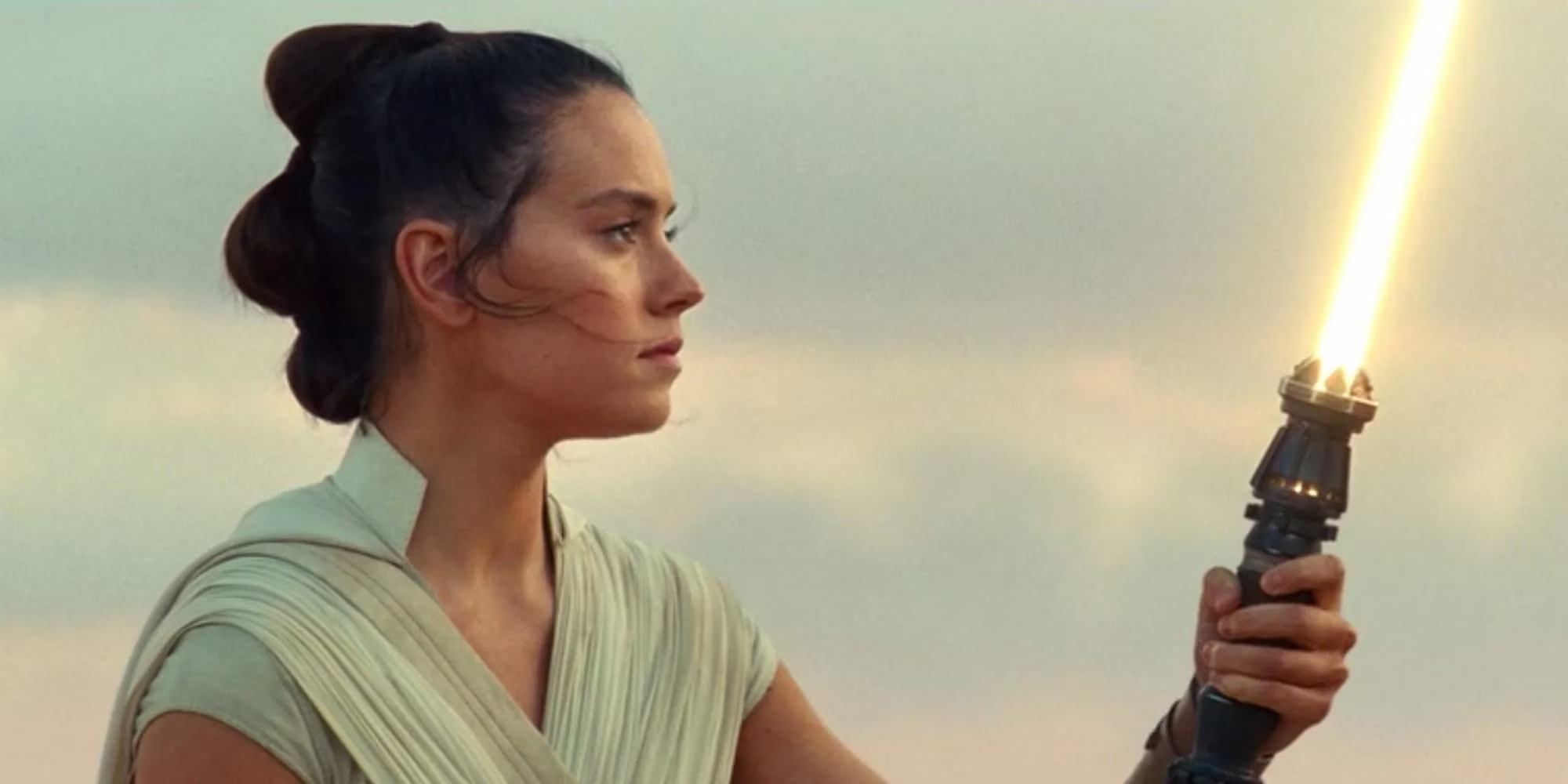
Fast forward to 2026, and that breathing room has long since evaporated. The change I noticed back in 2023 has only calcified into something approaching exhaustion. In 2019, Pedro Pascal’s Din Djarin was ushering in what felt like a glorious new era — finally, a Star Wars show that got it right, without overexplaining every single mystery. Yet that first season of The Mandalorian turned out to be the doorway to an absolute torrent of content. Since then, Disney has rolled out The Book of Boba Fett, Obi-Wan Kenobi, Andor, Ahsoka, and two more full seasons of Mando and Grogu’s adventures. And those are just the live-action titles. The animated pipeline has been relentless too: The Bad Batch, Visions, Young Jedi Adventures, Tales of the Jedi, and the final seasons of The Clone Wars and Resistance.
Patrick Willems made a fantastic video essay a few years ago arguing that the franchise still felt special in the pre-streaming-binge era, and I think about that all the time now. In 2023, I felt the first sharp pangs of saturation when I was about 15 hours into Star Wars Jedi: Survivor. Don’t get me wrong — it was a decent, competently made game. But just being in a Star Wars setting wasn’t enough to thrill me anymore. I kept comparing the experience to my first hours with Fallen Order in 2019, when I’d get goosebumps just hearing a lightsaber ignite or seeing a Star Destroyer loom in the sky. By 2023, after dozens of hours of TV shows filling every gap between movie releases, the wonder had quietly slipped away. The magic was diluted, and it wasn’t Respawn’s fault.
Now, in 2026, that threshold for excitement feels astronomically high. I used to think of Star Wars like a scarce, precious resource; now it resembles a 24/7 pipeline. The sheer volume of content has created a paradox: the more stories Disney tells, the less any one of them matters. It’s the same phenomenon we’ve seen with superhero movies — a mediocre entry could coast to a billion dollars a few years ago, but now even genuinely inventive ones struggle to stand out. Star Wars faces a similar test, and honestly, the bar has become exhausting to clear.
Take Star Wars Outlaws for example. When Ubisoft and Massive Entertainment first pulled back the curtain in 2023, I practically felt my younger self pumping a fist. An open-world Star Wars game where you could seamlessly hop into your ship and blast from a planet’s surface into space? That was the dream I’d nursed since childhood. Kay Vess seemed like the scoundrel protagonist we deserved, and I allowed myself to get swept up in the marketing. But by the time the game actually released in 2024, my anticipation had already curdled. I played the opening hours, and while the world was beautiful and the freedom undeniable, the novelty was gone. I kept finding myself wandering through cantinas and outposts thinking, “I’ve seen this. I’ve played this. I’ve lived this a dozen times over the last seven years.” A part of me resents that feeling, because the game itself isn’t bad — it’s just that Star Wars has been so ever-present that it no longer feels like an event. It feels like background noise.
The most damning part is that I’m aware I’m part of the problem. I keep watching, keep playing, keep hoping the next thing will recapture the lightning in a bottle that Andor achieved in 2022. And Andor did show me that brilliance is still possible — that a Star Wars story with real grit, character depth, and political weight can cut through the noise. But it also proved that you can’t manufacture that kind of resonance by simply churning out more volume. The franchise needed to go quiet for a while after Andor to let its impact settle. Instead, we got more, immediately, and the memory of that excellence got buried under the next shiny thing.
I’ve come to believe that the most exciting place Star Wars could go in 2026 isn’t a new planet, a new Jedi order, or a hidden Sith resurgence. It’s… away. A genuine rest, a purposeful hiatus that lets the dust settle and the longing reappear. Let fans miss it again. Let the familiar hum of a TIE fighter or the twang of a blaster become unfamiliar enough to trigger that old, childish glee. In a culture obsessed with endless content, stepping back might be the boldest move Disney could make. Because right now, with a new live-action show seemingly always around the corner and more games lurking in the release calendar, I catch myself barely flinching at a new trailer. That’s not what I want from a galaxy that once meant everything to me.
The irony is that the same business strategy that brought Star Wars to my living room every week has also made me take it for granted. The scarcity that defined my childhood and early adulthood — those long waits that made every poster, every trailer, every novel drop feel like a festive pilgrimage — has been replaced by a constant stream I can dip into like a tap. Convenience has killed the sacred. I’m not angry, just tired. And I genuinely hope that at some point, Disney realizes that Star Wars doesn’t need to be everywhere. It just needs to be special again, even if that means being gone for a little while.