
Mastering Silence: Top Stealth Games Where Sound Management is Key to Survival
Explore stealth games where sound is a core gameplay mechanic, transforming audio into a pivotal tool for survival and strategy. These immersive titles demand acute auditory awareness, making every noise a decisive factor.
In the intricate dance of stealth gameplay, where shadows and sightlines often dominate the conversation, the element of sound emerges as a subtle yet profoundly impactful force. By 2026, the legacy of games that treat audio not as a mere atmospheric detail, but as a core, interactive gameplay mechanic, remains a hallmark of the genre's most immersive and challenging experiences. These titles demand a player's acute auditory awareness, turning every footstep, door creak, and whispered conversation into a pivotal factor between success and catastrophic failure. The following exploration delves into the titles that have perfected this delicate balance, where mastering silence is the true art of the unseen.
Emerging from the shadows of its predecessors, Tom Clancy’s Splinter Cell: Chaos Theory stands as a monumental pillar in stealth design, its systems feeling remarkably sophisticated even decades after its release. The game's intelligence is not just in its clever level design, but in its enemies. Guards exhibit startling awareness; they will move objects to create cover for themselves and, upon hearing a suspicious noise, can light flares in dark areas to hunt down Sam Fisher. Perhaps most famously, they can even spot his reflection in a mirror. Central to the player's strategy is the aural monitor on the HUD, a visual representation of the noise Sam is making against the ambient din of his environment. To truly ghost through a mission, one must become quieter than the surrounding world itself. This creates a tense, almost musical interplay with the environment, where the hum of machinery or patter of rain becomes your ally.
The dystopian, turn-based world of Invisible, Inc. presents a cerebral challenge where every decibel counts. Set in a 2074 dominated by megacorporations, agents must navigate procedurally generated facilities to rescue their AI, Incognita. While positioning out of sight is crucial, sound management is the linchpin of every turn. Sprinting, melee attacks, and gunfire all generate noise that can trigger alarms and send guards swarming. However, this system is beautifully double-edged. A strategically created sound can lure a guard to an isolated location for a clean takedown or serve as a perfect distraction to slip an agent through a heavily monitored corridor. It transforms sound from a liability into a versatile tool, demanding players think several moves ahead in a high-stakes game of corporate espionage chess.
Contrasting sharply with high-tech espionage is the grim, survivalist reality of This War of Mine. Here, you are not a super-spy, but a desperate civilian scavenging by night in a war-torn city. The stakes of noise are brutally pragmatic. During the day, your shelter is a sanctuary of relative safety where noise is inconsequential. At night, however, every action in the ruins of Pogoren is fraught with peril. Running, forcing doors open, or engaging in combat can attract the attention of hostile survivors, leading to a deadly confrontation for which your character may be woefully unprepared. The game provides a chillingly effective visual cue: translucent sound waves that pulse through walls, indicating the origin of a noise. Sometimes it's you; sometimes, it's a sign that you are not alone in the darkness, ratcheting up the tension to almost unbearable levels.
For a masterclass in 2D stealth, Mark of the Ninja remains unparalleled. It brilliantly visualizes the auditory landscape that other games leave to imagination. As the unnamed ninja moves, growing circles ripple from his feet, clearly indicating the radius of sound he generates. A careful, slow walk produces barely a whisper, while a run or a fight creates loud, visible waves that will alert nearby enemies. This elegant feedback loop allows for precise planning. The game also introduces psychological warfare through sound and sight; leaving a visible corpse for enemies to find will send them into a panic, a tactic that is deeply gratifying when executed from the silent shadows. It's a game that makes you feel like a ninja by making every aspect of stealth tangible.
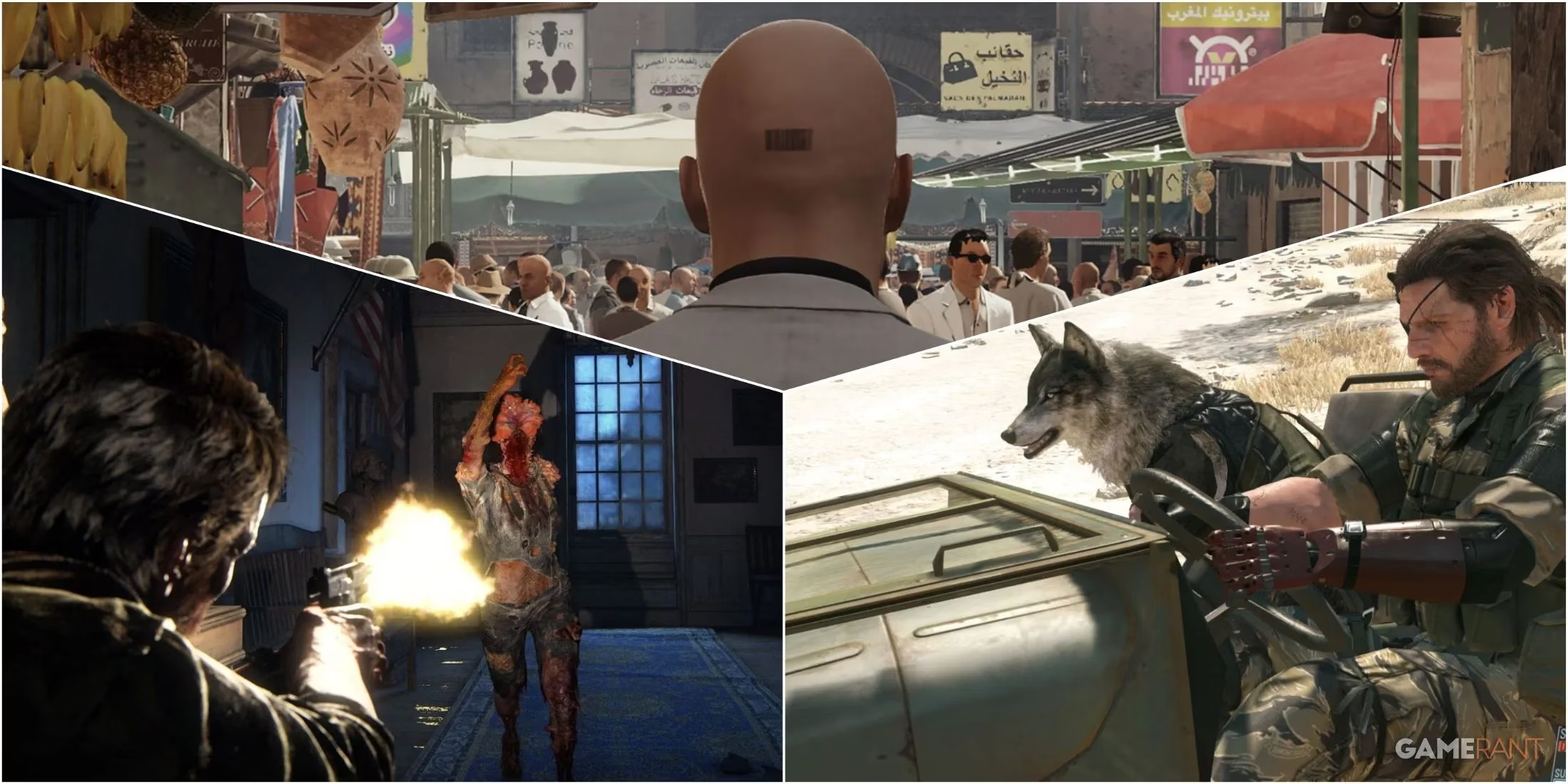
In the vast, open sandboxes of the Hitman World of Assassination trilogy, sound is one of Agent 47's most versatile instruments. While disguises and social stealth are paramount, audio plays multiple critical roles. Eavesdropping on conversations is often the key to unlocking new mission stories and elaborate assassination opportunities. More directly, the simple act of tossing a coin is a foundational tactic, a tiny, controlled noise used to manipulate the patrol patterns of NPCs, luring them away from posts or into isolated corners. Conversely, uncontrolled noise—loud takedowns, unsuppressed gunfire—is typically a one-way ticket to a compromised mission and a frantic firefight. The balance between using sound as a scalpel and avoiding it becoming a sledgehammer defines the gameplay of a master assassin.
Hideo Kojima's open-world opus, Metal Gear Solid 5: The Phantom Pain, gives players an incredible amount of freedom in how to approach its infiltration missions. While going in guns blazing is an option, the game richly rewards silent, methodological play. Sound is a primary tool for manipulation. Knocking on a wall or tossing a magazine will cause a guard to break from his routine and investigate, allowing Venom Snake to isolate and subdue them without raising a base-wide alert. The game's progression system actively supports this playstyle, unlocking an arsenal of silent weapons, tranquilizer darts, and sleep gas grenades. The iconic Fulton recovery system is itself a lesson in noise management—extracting a resource container is loud and will draw attention, while extracting a sedated soldier is blissfully quiet.
At the other end of the technological spectrum lies the foundational Thief series. In the gloomy, gaslit streets of The City, master thief Garrett has no convenient HUD meter for sound. Players must rely entirely on their own ears and instinct. The rustle of his cloak on a stone floor, the crunch of glass underfoot, or the distinctive clink of a looted gold coin—all these sounds are contextual and perilous when guards are near. The game’s audio design is so precise that listening becomes your primary sense; you can hear the footsteps and muttered conversations of guards through doors, allowing you to time your movements with supernatural precision. Success demands a cautious, almost meditative approach where you become one with the ambient soundscape.
Finally, The Last of Us uses sound not just as a mechanic, but to build its entire oppressive atmosphere. In a world reclaimed by nature and infected horrors, stealth is often the only path to survival. The game introduces terrifying auditory-based enemies like the Clickers, blind creatures that use echolocation to hunt. Making any noise near them is fatal. This makes every encounter a tense exercise in slow movement and environmental manipulation. Joel's listen mode ability—allowing him to hear enemies through walls—is a crucial tool that emphasizes the game's focus on audio awareness. Beyond gameplay, the masterful sound design, from the haunting score to the unsettling ambient noises of abandoned cities, works in concert with the mechanics to create one of the most consistently tense and emotionally resonant experiences in gaming.
From the gritty realism of survival to the polished execution of espionage, these games prove that in the realm of stealth, what you hear—and what you are heard doing—is just as important as what you see. They challenge players to master the space between sounds, to use silence as a weapon, and to remember that sometimes, the loudest statement is the one never made.
The following breakdown is based on Rock Paper Shotgun, a leading source for PC gaming insights and reviews. Their coverage of stealth games frequently emphasizes the importance of sound design, noting how titles like Thief and Mark of the Ninja set benchmarks for immersive audio mechanics that directly impact player strategy and tension. By analyzing the interplay between environmental noise and player actions, Rock Paper Shotgun highlights how mastering silence is not just a gameplay choice but a defining skill in the genre.