
Ghost of Yotei's Anthology Leap: How Sucker Punch Outsmarted The Last of Us' Legacy Trap
Ghost of Yotei and Sucker Punch's sequel strategy redefine emotional samurai stories, offering breathtaking, anthology-style adventures.
In 2026, the gaming landscape still buzzes with the seismic tremor caused by Sucker Punch's masterstroke: the announcement of Ghost of Yotei. After a prolonged silence that had fans checking their calendars for a time paradox, the State of Play finally unveiled the sequel, not as a direct follow-up to Jin Sakai's tale, but as a bold, centuries-later anthology piece starring a new Ghost, Atsu, on the icy slopes of Mount Yotei. This wasn't just a new chapter; it was Sucker Punch rewriting the entire rulebook for its franchise right before our eyes, a move as clever as a ninja swapping places with a log mid-fight.
While Jin Sakai's journey on Tsushima became a cultural touchstone, Sucker Punch faced a classic sequel dilemma. Do they force more story from a character whose arc felt complete, risking dilution like over-steeped tea? Or do they dare something new? They chose the latter, and in doing so, unlocked a storytelling vault with seemingly infinite combinations. Ghost of Yotei severs the direct narrative tether, reimagining the Ghost origin story over 300 years later. This transforms the franchise from a linear saga into a potential anthology series—a kaleidoscope of feudal-era stories where each turn reveals a new protagonist, setting, and era. Jin and Atsu could be merely the first two threads in a vast, unspooling tapestry of Ghosts. The franchise's lifespan is now tied only to the developers' creativity for "emotional samurai/ronin stories in breathtaking vistas," a well that looks decidedly bottomless.
This strategic pivot is a masterclass in forward-thinking IP management. Sucker Punch, having honed its craft on Tsushima, now gets to rewrite the textbook for its own series. Yotei becomes a canvas for every mechanic, narrative beat, and visual flourish the team wished it had implemented the first time around. This process is repeatable: each new entry can engross players in gorgeous, historically-inspired Japanese settings while telling distinct stories and inheriting refined gameplay mechanics. It ensures every installment carries its own signature stamp, preventing the series from becoming a museum diorama—beautiful but static. Atsu, as a new protagonist, is a blank washi scroll, immediately more enticing because her story is wholly unknown, defined initially only by the weapons she carries and the new frontier she inhabits.
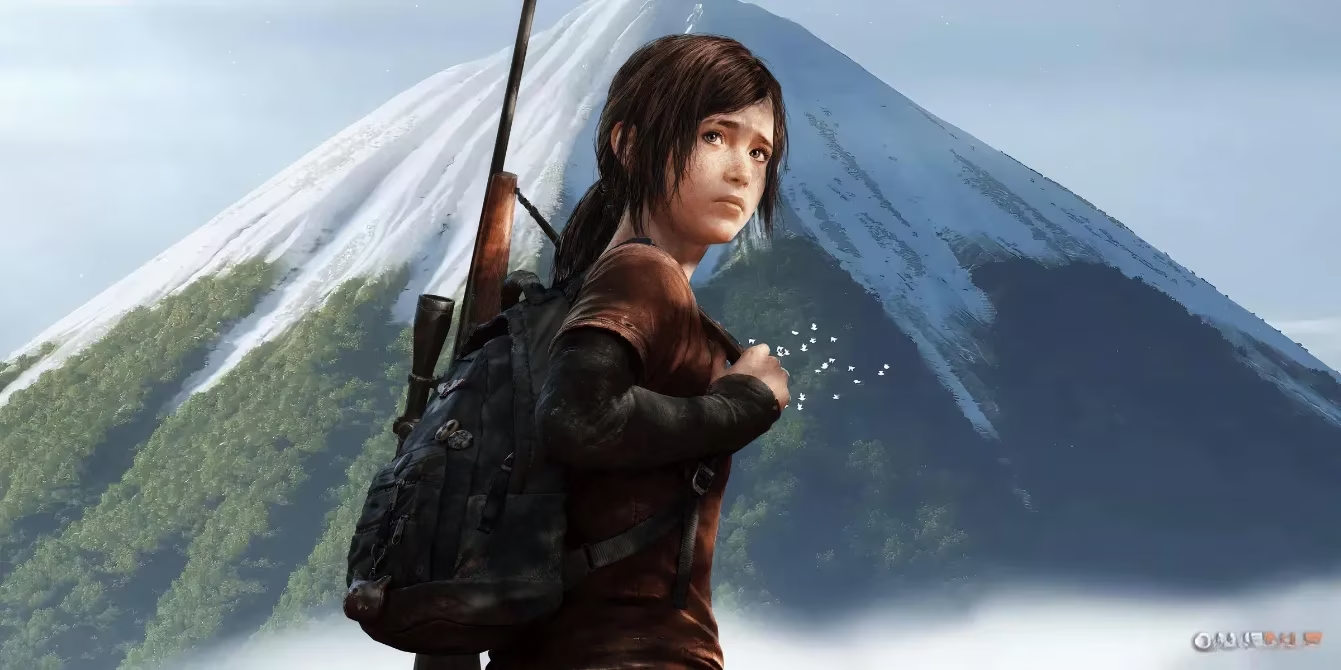
This approach shines a particularly harsh, critical light on the path chosen by another PlayStation narrative giant: Naughty Dog's The Last of Us. The article draws a sharp, almost cautionary comparison. Naughty Dog's characters are written so well, so indelibly, that they become a narrative blessing and a curse. The audience's deep connection demands sequels to provide closure or continue their stories, creating a legacy trap. Joel's death in Part II and the violent fan reactions are cited as proof of this intense, almost possessive attachment. With Neil Druckmann hinting at "probably one more chapter" for Ellie, the franchise feels needlessly limited. In a world ripe for endless stories of survival and human connection, it remains anchored to the exploits of its original duo. The canceled multiplayer project, ironically, might have been the perfect outlet to explore other perspectives, a chance now seemingly lost.
Ghost of Yotei’s model offers a stark alternative. It demonstrates that a powerful franchise identity doesn't need to be welded to a single protagonist or storyline. By making the "Ghost" a mantle, a legacy, or a recurring archetype, Sucker Punch has built a narrative perpetual motion machine. They've avoided the creative cul-de-sac and ensured the series won't grow stale. The article posits that The Last of Us "would be wise to take heed of before it’s too late," suggesting that its reliance on Ellie's specific journey could eventually feel restrictive compared to the boundless potential of the Ghost anthology format.
In essence, Sucker Punch didn't just announce a sequel; they performed a strategic konjac jelly maneuver—slipping out of the tight constraints of a direct sequel narrative and reshaping themselves into something more fluid and expansive. While one beloved franchise prepares to (likely) say a final goodbye to its iconic hero, another has just discovered how to make its core concept immortal, ensuring that the way of the Ghost will never grow old, only evolve.