
Gaming's Apology Card Era: Why Sorry Isn't Enough in 2026
The gaming industry's corporate apologies have become industrialized apology cards for buggy launches. It turns regret into a meme.
By 2026, players have become fluent in a very specific dialect of corporate regret. It arrives as a square image: a muted logo, a paragraph of carefully worded sorrow, a promise to do better, and a line about listening to feedback. It gets posted on social media, screenshotted, turned into a meme, and forgotten. The ritual is so familiar that it might as well have its own font. The gaming industry has not stopped apologizing. It has industrialized the apology.
Apologies in gaming are nothing new. There was a time when publishers said sorry for PR disasters, like an 8Chan Q&A or a marketing email joking about a government shutdown. Those were ugly, but they were also specific. The newer wave is different. It is almost always the same format: a little graphic with an apology written on it, designed to be passed around on social media. And it is almost always about the same thing: an underwhelming release.
The pattern arguably started with Cyberpunk 2077's January 2020 delay, even though that was an apology for a delay rather than a broken launch. From there, the format spread like wildfire. In 2023 alone, players saw similar statements from the teams behind the PC port of Star Wars Jedi: Survivor, The Lord of the Rings: Gollum, and Forspoken. Each game had its own problems, but the apology card looked as if it had been pulled from a shared template. When Redfall stumbled at launch, some people began making parody apologies in the exact same style. The trend became so widespread that joke templates started circulating. A corporate apology had become a meme format.
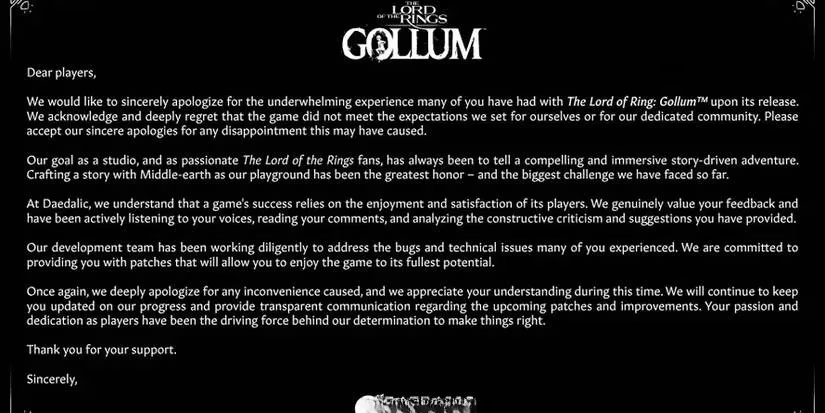
There is nothing inherently wrong with apologizing after a mistake. In fact, it is what companies are supposed to do. But several things about this trend stand out. The first is the strange visual uniformity. Part of it may be practical: a single image can bypass character limits on social media platforms. Still, the mental image of gaming executives gathering around a table to agree on the same apology template is difficult to shake. It is funny in a bleak way.
The second problem is what many of these games are apologizing for: bugs. Star Wars Jedi: Survivor's PC port, Gollum, and Grand Theft Auto: The Trilogy - The Definitive Edition were all criticized for technical messes at launch. These were not merely divisive creative choices. They were products that needed fumigation. That matters because bugs are objective. Unlike a gameplay system that can be debated, almost nobody will defend clipping through the map as an artistic decision. A bad but functional game can still inspire arguments about its merits. A broken game often skips that debate and goes straight to becoming the internet's punching bag.
That objectivity should make the apologies more reasonable, but the sheer number of them works against the concept. Players could see many of these problems coming from a mile away. Time and again, the public asks for delays. Delays are not a foolproof tactic, but they are often better than releasing a game that cannot function. Yet bug-filled titles keep getting pushed out the door, followed by the same apology graphic.
At that point, the apology starts to look less like accountability and more like an excuse. Publishers and studios understandably want to be seen as transparent. A quick statement can create that impression. But the purpose of an apology is to learn from a mistake. If different companies keep issuing the same apology for the same category of failure, the industry appears to be going in circles. These statements come from different sources, but the companies involved have some level of perception. They can see what happened to everyone else. They can see the mockery. They can see the refund requests. Repeating the cycle suggests that the lesson is not being learned.
A quick look at the apology era shows how repetitive the flashpoints have become:
| Release | Main flashpoint | Apology style |
|---|---|---|
| Cyberpunk 2077 | Delay and later launch issues | Social media statement |
| Grand Theft Auto: The Trilogy - The Definitive Edition | Bugs and technical problems | Social media statement |
| Star Wars Jedi: Survivor PC port | Performance and stability issues | Social media statement |
| The Lord of the Rings: Gollum | Quality and bugs | Social media statement |
| Forspoken | Mixed critical reception | Social media statement |
| Redfall | Critical disappointment | Official response and parody cards |
| The Last of Us Part 1 PC port | Bugs and performance | Social media statement |
None of these problems were mysteries. In most cases, the warning signs were visible before launch. The apology arrives after the damage, when refunds, review bombs, and angry forum threads have already done their work. It is a bandage on a wound that could have been treated with more time.
By 2026, the apology card has not disappeared. It remains a default crisis-response tool. But players have grown more skeptical. They have seen too many square images with too many sad paragraphs. They know that an apology can be sincere, but they also know it can be a cost-effective substitute for change. A statement takes minutes. A proper delay, a larger QA budget, or a decision to ship a game only when it is ready takes courage and money.
Most players would rather see a publisher put up or shut up. Give the developers enough time to polish the game. Delay it if necessary. Communicate honestly before launch, not after. Do not condescend to the audience with a cookie-cutter apology that can be turned into a meme before the weekend. Trust is not rebuilt by a graphic. It is rebuilt by shipping a game that works.
That is the real lesson of the apology era. A sorry can be a start, but it cannot be the whole strategy. In 2026, the players are still waiting for the follow-through. They remember the broken launches. They remember the excuses. And they remember the apologies that looked exactly the same as everyone else's. 🎮🐛