
From Lost to Found: Video Game Protagonists Who Discovered Their True Selves
Broken video game protagonists and flawed heroes captivate players with gripping journeys of self-discovery and emotional storytelling.
As a gamer in 2026, I've seen countless heroes on screen, but the ones that stick with me aren't the invincible warriors—they're the broken ones, the lost souls just trying to figure out who they are. You know the type. Modern games have this knack for putting us in the shoes of characters who are, frankly, a bit of a mess. And honestly? That's what makes them so compelling. We get to walk alongside them through their personal crises, watching as grief and confusion slowly give way to self-discovery. It's a journey from being utterly lost to finally finding a reason to keep going, and man, when that moment hits... it hits hard. These characters don't just save the world; they save themselves, and we're right there with them for every painful, beautiful step.
The Amnesiac Detective with a Heart of Gold
Let's talk about Disco Elysium first. When you first meet the detective, well, he's a hot mess. A self-destructive drunk constantly at war with his own thoughts—you can't help but think, "This guy is pathetic." But here's the thing: buried under all those bottles of booze is a competent detective with a heart heavier than a lead balloon. The whole game is this amazing narrative where you piece together not just a case, but him. By the end, that heartfelt conversation with the mental projection of his fiancée... it's something else. Discovering he's Harrier Du Bois isn't just a plot point; it's him finally finding his way. You feel like you've helped pull someone back from the brink. The writing in that game? Top-tier. No question.
The Immigration Officer Facing Impossible Choices
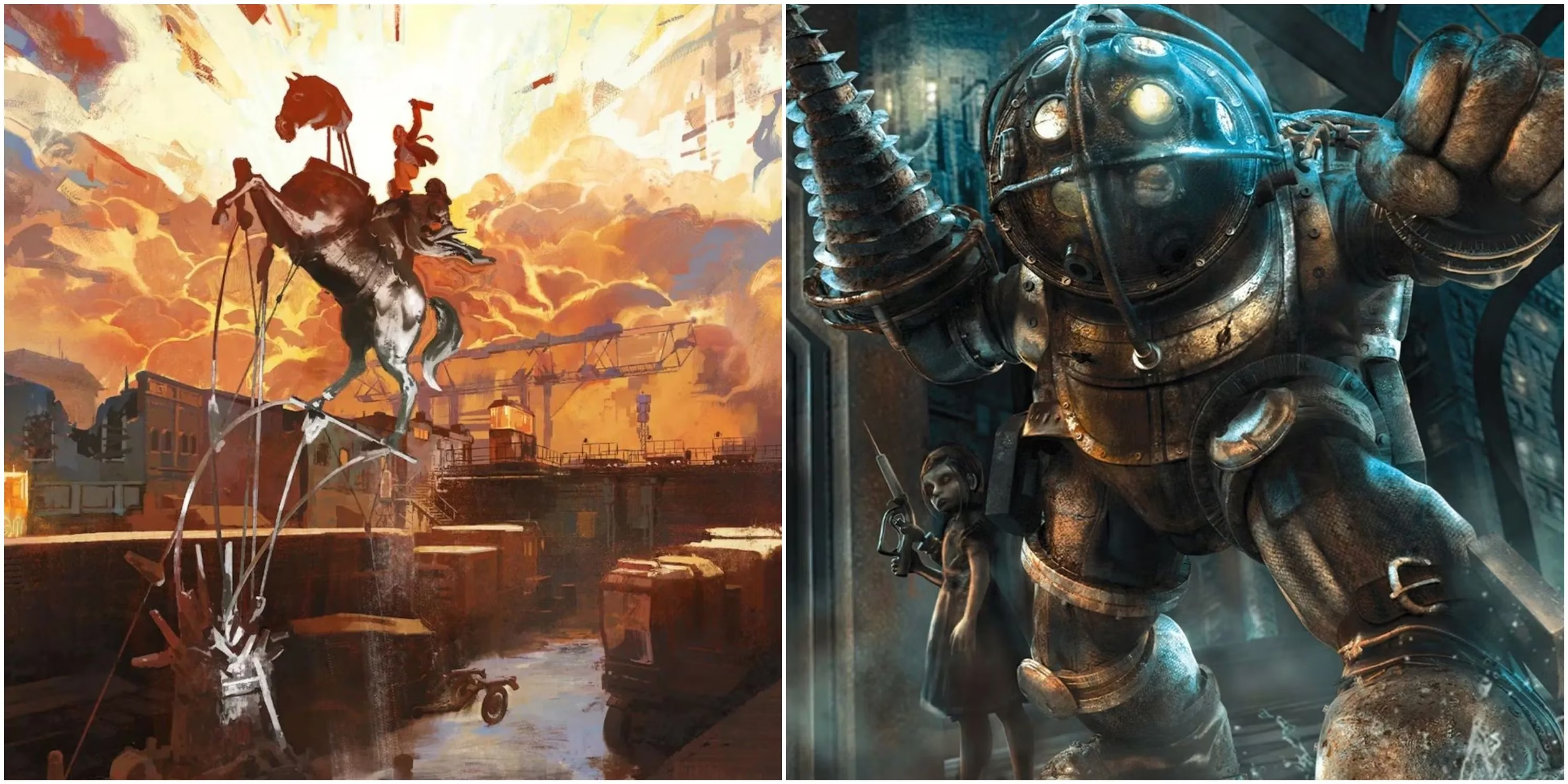
On paper, Papers, Please sounds boring. You're an immigration officer checking papers—big whoop, right? Wrong. This game is a masterclass in political intrigue and human empathy. It forces you to decide, over and over: your family or your humanity? Do you take that bribe to feed your kids? Let in that desperate soul knowing it might cost you? By the time the credits roll, you don't just finish a game; you get a stark look in the mirror about the kind of person you are. It's harrowing, full of those uncomfortable, quiet moments that linger long after you've put the controller down.
The Unwitting Pawn in an Underwater Nightmare
BioShock starts with Jack, a hapless passenger surviving a plane crash and stumbling into the underwater city of Rapture. Seems straightforward. But then... boom. The reveal. Those memories? A complete farce. Jack is Andrew Ryan's illegitimate son, a pawn meticulously manipulated by Frank Fontaine to kill his own father. Talk about a family reunion gone wrong. It's a mind-blowing twist that shows just how layered the plot is. The beauty is in Jack's struggle to overcome his own programming. His ending—whether he saves or harvests the Little Sisters—isn't just a moral choice; it's him defining who he wants to be after the truth shatters his world.
The Ghost Who Wasn't What He Seemed
Sissel from Ghost Trick: Phantom Detective wakes up dead. He's a ghost with amnesia, a blond guy in a red suit. But from the get-go, things feel... off. He can't read. He can see perfectly in the dark. Why does he have memory loss when other ghosts don't? The answer is one of the most delightful, left-field twists in gaming history: Sissel was a cat all along. I mean, come on! It's a genius reveal that recontextualizes everything. He wasn't a lost human soul; he was a loyal pet trying to solve his own murder and save his owner. It’s a fun, heartfelt twist that perfectly caps off a brilliant adventure.
| Character | Game | Initial State | Core Discovery |
|---|---|---|---|
| The Detective | Disco Elysium | Amnesiac, self-destructive drunk | Identity as Harrier Du Bois |
| The Officer | Papers, Please | Struggling bureaucrat | The cost of one's own morality |
| Jack | BioShock | Manipulated amnesiac | He is Ryan's son, a weaponized pawn |
| Sissel | Ghost Trick | Amnesiac ghost | He was a cat protecting his owner |
The Jedi Who Was Once a Sith Lord
Knights of the Old Republic drops you in as another amnesiac, fleeing a doomed ship. You manifest Jedi powers, gather a crew... it feels like a classic hero's journey. Then the game pulls the rug out from under you. You're not just some random Force-sensitive. You are Darth Revan, the fearsome Sith Lord, captured, mind-wiped, and reprogrammed. It's a monumental twist that asks a profound question: does your past define you? The game then gives you the ultimate choice: embrace the Light Side as a redeemed hero, or fall back to the Dark Side and reclaim your old mantle. The power is literally in your hands.
The Husband Haunted by His Own Sin
The Silent Hill 2 remake has introduced a new generation to James Sunderland's devastating pilgrimage. He's searching for his wife, Mary, in the fog-shrouded town. But Silent Hill doesn't harbor strangers; it mirrors the inner turmoil of those who enter. James's truth is the most horrifying of all: there is no letter from Mary. She died long ago, not from illness, but by his hands. He smothered her, unable to bear her suffering, and buried the memory. The town and its monsters—especially Maria, who dies repeatedly—are manifestations of his crushing guilt. His journey isn't about finding his wife; it's about facing the monster he became.
The Soldier Living Another Man's Life
Final Fantasy VII's Cloud Strife is the poster boy for identity crises. From the moment you leave Midgar, things feel shaky. Tifa's silent doubts, the discrepancies in his Nibelheim story... it all crescendos after Cloud, manipulated by Jenova's cells, hands Sephiroth the Black Materia. Cast into the Lifestream, poisoned by Mako, his fractured psyche finally breaks. With Tifa's help, he pieces together the truth: he never made SOLDIER First Class. He's a regular infantryman who survived horrific experiments and, in his trauma, absorbed the identity and memories of his friend and hero, Zack Fair, who died saving him. Cloud's entire persona was a coping mechanism. Watching him slowly, painfully, rebuild his real self is one of gaming's greatest character arcs.
The Father Who Chose One Over Many
And then there's Joel in The Last of Us Part I. His apathy is a fortress, built brick by brick after losing his daughter Sarah on Outbreak Day. Escorting Ellie across the country? Just another job. But life, uh, finds a way. Their journey isn't about crossing miles; it's about bridging the chasm in Joel's soul. Ellie doesn't just remind him of his daughter; she becomes his daughter. She repairs his humanity, giving him purpose again. But this love has a terrifying, dark side. At the hospital, learning the Fireflies' cure would kill Ellie, Joel makes his choice. He doesn't hesitate. He slaughters his way to her, sacrificing humanity's last hope to save the one person who made him feel human again. It's not heroic. It's brutally, devastatingly paternal. And it leaves you wondering... what would you have done?
Looking back at these stories in 2026, the pattern is clear. The most memorable journeys aren't about defeating the big bad. They're internal. They're about characters sifting through the wreckage of their lives—or memories planted there—to answer the simplest, hardest question: Who am I? Whether it's a detective, a cat, a former Sith Lord, or a broken father, their power comes from their profound vulnerability. They show us that sometimes, the bravest thing you can do is simply face yourself. And honestly, isn't that a quest we're all on, in one way or another?