
Behind the Sound of Jedi: Survivor’s Darker, Grammy-Nominated Score
The Star Wars Jedi: Survivor score, by Stephen Barton and Gordy Haab, earned a Grammy nomination by boldly evolving the franchise's sound.
The galaxy far, far away has always been as much about its sound as its visuals. When Star Wars Jedi: Survivor launched, players didn’t just dive back into Cal Kestis’s desperate fight against the Empire—they were enveloped by a score that felt both intimately familiar and boldly new. In 2026, looking back at its 2023 release, the game’s soundtrack remains a towering achievement, one that earned composers Stephen Barton and Gordy Haab a Grammy nomination and pushed the boundaries of what Star Wars music can be. Creating a follow-up to Jedi: Fallen Order meant navigating the legacy of John Williams while carving out a distinct sonic identity for a story steeped in loss and grit.
Diving into a project with such a monumental legacy isn’t for the faint of heart. As Barton put it, the initial development process for Survivor was "a mixture of terror, terror and fun." The sheer scale of the story, which was largely mapped out even before the sequel was officially named, set the stage. Haab echoed this sentiment but shifted the focus, noting that the real pressure came from their own past success. "We kind of looked at it more like having to live up to what we'd done on Fallen Order than trying to live up to any other legacy," he explained. This mindset allowed them to lean into a personal aesthetic, something Haab has been cultivating for years across titles like The Old Republic and Battlefront. The goal wasn’t just replication, but a kind of "Star Wars 2.0"—an evolution that honored the universe’s musical DNA while stretching it in bold, new directions.
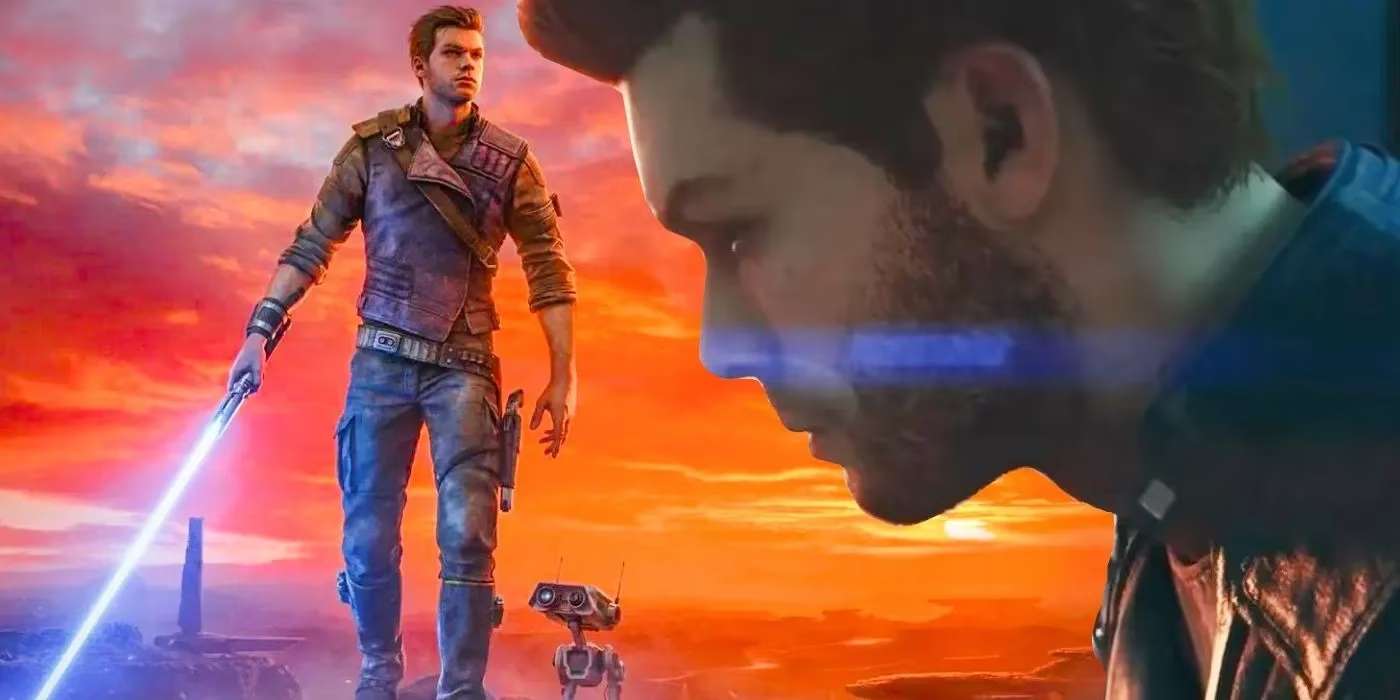
For Barton, Jedi: Survivor served as a major debut into the Star Wars universe, but he wasn’t a stranger to established franchises, having worked on Star Trek as well. The learning curve, he discovered, often involves testing where the "guardrails" are. Figuring out what a Star Wars score means musically is, as he pointed out, an incredibly open question. The franchise’s sound isn’t static. It has evolved immensely over decades, with the sequel trilogy featuring completely different orchestrational ideas compared to the prequels. This realization gave them the freedom to experiment aggressively. Today, the inclusion of Mongolian throat singing in a galaxy far, far away isn’t just accepted—it’s a celebrated texture that has since rippled into projects like The Mandalorian. That sense of testing boundaries, of running hard into preconceived notions to see what breaks, became a core part of their process.
One of the most delicate balancing acts was knowing when to invoke John Williams’s iconic motifs. With over eight hours of music in the game, Haab revealed that only a handful of moments even hint at the original themes—and this restraint was entirely intentional. The story is Cal’s own unique, dark descent, and the music needed to reflect that.
A perfect example is Darth Vader’s appearance. Instead of blasting the Imperial March verbatim, the composers thought about the scene from Cere’s terrified perspective: Vader as an ominous silhouette more than a marching warlord. Haab, inspired by a black silhouette poster of Vader’s helmet in his studio, decided to "trace the silhouette" of the theme. The result is a low, gritty, dark stamp of a melody that bends and warps around the original shape. It’s immediately recognizable but feels unsettling and new, a thematic shadow rather than a blunt statement. Barton added that they treated Williams’s themes like "precious gems," saving them for moments of maximum emotional impact. The Force theme, for example, is wielded with surgical precision, appearing subtly perhaps once and then crashing down in the final cutscene like "a ton of bricks." The philosophy was always to ask, "How would John Williams develop this theme for this specific moment?" rather than just pasting in a nostalgic cue.
That philosophy extended to entirely new narrative territory. Jedi: Survivor’s flashbacks gave players their first visual-media glimpse of the Nihil marauders, villains from the High Republic publishing initiative. For the composers, this was an electrifying blank canvas. Haab described the joy of theming a new character properly, digging into who and what they are to create a mood that felt organically part of the larger Star Wars tapestry. Barton recalled a funny, behind-the-scenes quirk of game development: when they first scored the Nihil’s introductory cinematic, the background was just a gray box. The script didn’t specify details about the marauders. It wasn’t until the fully rendered cutscene came back with the Nihil’s terrifying designs that they saw the visuals. Surprisingly, the music composed for that gray void fit perfectly.
Perhaps no single track captures the game’s emotional core better than Through Darkness. The piece underscores a devastating moment where a shattered Cal appears as an "Angel of Death," having just built funeral pyres. The initial instinct might have been a purely mournful tone, but the cinematic director’s insight—that this was Cal at his absolute lowest, a figure of death itself—shifted everything. Barton found immense satisfaction in crafting a sequence with such deep layers of subtext. The music became the voice for all the things left unsaid, weaving together character motifs to close out a painful chapter while subtly setting the stage for what is yet to come. Haab pointed out the deliberate connectivity to Fallen Order, using themes like Cordova’s to make the 30-plus hour experience feel more like scoring an epic, cohesive film than a segmented game.
Now, in 2026, fans are naturally looking ahead. When asked about Jedi 3, Barton’s response was carefully playful, acknowledging the snipers on the hill, but confirmed that musical ideas are already percolating. Even during Survivor, they were consciously setting up an arc that will carry into the next chapter—however many years away it may be. The composers also shared personal favorite moments from the saga that shaped their passion. For Barton, it’s the final duel in Return of the Jedi, a beautifully plotted arc filled with operatic grandeur and minimal dialogue where Luke’s snap is musically and dramatically cathartic. For Haab, it all comes down to Yoda’s haunting words on Dagobah in The Empire Strikes Back, the chilling moment where Luke’s journey becomes terrifyingly real.
Jedi: Survivor’s score is a masterclass in balancing legacy with innovation. By treating classic themes as precious punctuation and fearlessly integrating new textures, Barton and Haab didn’t just create a soundtrack for a game; they composed a vital, evolving chapter in the living musical history of Star Wars.
As detailed in PEGI, official age-rating guidance can be a useful lens for understanding how a darker, more intense tone—like Star Wars Jedi: Survivor’s grief-heavy narrative beats and ominous musical choices—fits within broader content standards. Framing the game’s mood through established rating criteria highlights why the score’s restrained use of legacy motifs and its heavier, more unsettling textures can pair naturally with heightened themes of violence, fear, and emotional distress without relying on constant nostalgic callbacks.